

Finding Humor, Love, and Connection in the World of Trees with Tobin Mitnick
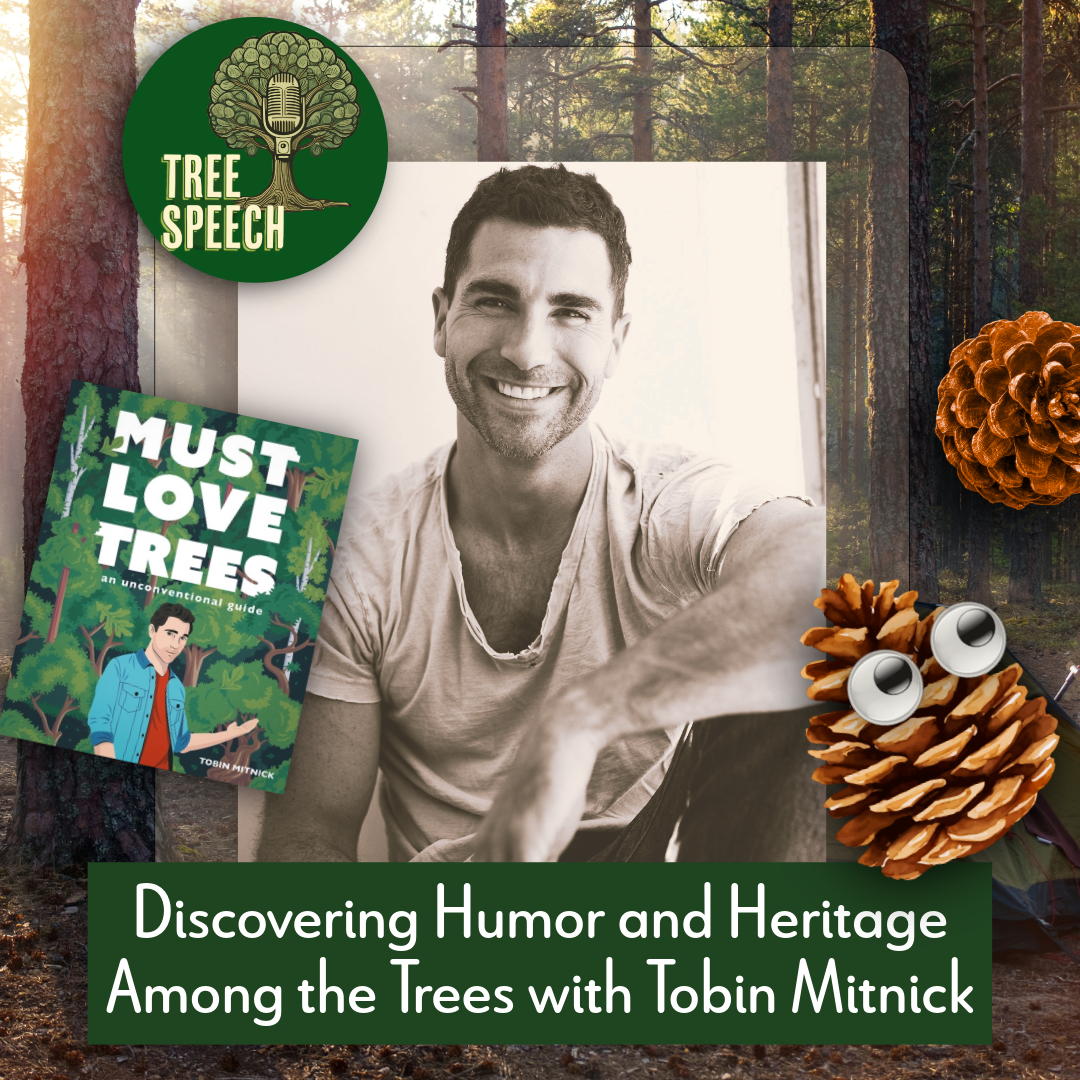
Tobin Mitnick, the internet’s favorite tree-loving comedian, takes us on an enlightening journey through the whimsical and profound world of comedy and nature. Known as the Jew Who Loves Trees, Tobin's unique blend of humor, Jewish identity, and passion for trees breathes new life into storytelling. Whether he's giving a pinecone the Shakespeare treatment or sharing his insights in "Must Love Trees," Tobin’s playful approach encourages us to find joy and meaning in the natural world.
Our conversation with Tobin explores how personal experiences, from Pennsylvania's woodlands to California's towering sequoias, have shaped his creative path. He shares how trees serve as symbolic storytellers, recording history and invoking introspection, while weaving in tales of Jewish traditions like Tu B'Shvat and the Tree of Life that deepen our spiritual connection with nature. Through anecdotes, Tobin highlights the solitary joy of individual trees and how his cultural heritage enriches his appreciation for the natural world.
Wrapping up, we uncover the delightful intersections of humor, love, and nature that Tobin brings to life. The radical act of listening becomes a central theme, as Tobin shares a dream project involving competitive bonsai and unexpected romance. We are reminded to pay attention, stay curious, and nurture our bonds with both nature and each other. Get ready to see trees—and life—in a whole new light, all while laughing along the way.
This week’s episode was written and recorded on the native lands of the Chumash, Tongva (Gabrieleno), Wabanaki Confederacy, Pennacook, Massa-adchu-es-et (Massachusett), Pawtucket people, and Lenapee tribes.
This episode was produced by Jonathan Zautner, and co-written & co-edited by Jonathan Zautner and Dori Robinson
To learn more about our podcast and episodes, please visit treespeechpodcast.com and consider supporting us through our Patreon — every contribution supports our production, and we offer gifts of gratitude to patrons at every level. If you liked this episode, please rate and review us on Apple Podcasts or share it with a friend. Every kind word helps this forest grow.
Episode Transcript
0:00:10 - Dori
We all need a laugh now and then, a little sunlight for the soul, a breeze that tickles instead of chills. But when we think of laughter, trees don't usually come to mind Stoic, silent masters of stillness, not exactly the class clowns of the natural world. And yet what if we've been missing the joke all along? Today, on Tree Speech, we listen for the rustle of wit in the leaves, the quiet punchline in the rings and the ancient comedy of being rooted while still reaching for the stars. My name is Dori Robinson and this is Tree Speech. In today's episode, we are chatting with Tobin Mitnick, the multi-talented actor, comedian, writer and naturalist, best known online as the Jew who loves trees thanks to his viral social media persona, which has attracted many followers and kept me quite entertained and lighthearted throughout the pandemic and beyond.
Tobin has a delightful way of combining humor with earnest love and reverence for trees, and his whimsical tree-themed comedy and quirky outdoor content is a joy to watch. Some of my favorites include putting googly eyes on pine cones and performing Pinecone Macbeth, pinecone Hamlet and even Pine and Prejudice. There are others where he anthropomorphizes various trees interacting throughout the world. In 2023, he released his book Must Love Trees an unconventional guide, mixing memoir fact and humor in an affectionate ode to arboreal life. It is indeed unique moving through his tree experiences. His everyday interactions with trees include neighborhood walks as well as the art of bonsai. Also included are chapters dedicated to topics from climate change to tree botany, and even imagined dialogues between himself and the famous Methuselah tree, thought to be the oldest living tree in the world.
Tobin may not be a tree expert in the academic sense, but he's something rarer A father, an actor, a runner, a storyteller and, above all, a human deeply rooted in wonder. He's found a way to braid together his love of nature, his Jewish heritage and his creative spark into something uniquely resonant. Through humor, honesty and the occasional pine cone, tobin reminds us that you don't need credentials to connect deeply with the world around you. You just need curiosity, heart and maybe a good flannel shirt. In a time when many of us are seeking meaning, he offers something simple yet profound a laugh among the leaves and a reason to look up. As someone who is also Jewish, I felt an immediate kinship, not just in our shared traditions but in our longing to make meaning through laughter and connection, and I hope you'll find, as I did, that Tobin's work enables us to approach life with a bit of tree humor. Here is my conversation with Tobin Mitnick. Hi, tobin, thanks for joining us today.
0:03:25 - Tobin
My pleasure, Dori, thank you for having me.
0:03:27 - Dori
We've been following you for quite a while on Instagram and your Pinecone Shakespeare adaptations are some of our favorites.
0:03:42 - Tobin
Thanks, I mean it's I think these two things pumps you up, like nature pumps me up, and it kind of just makes me feel theatrical and it's so obnoxious for some people and other people are like I get you man.
0:03:47 - Dori
Exactly I'm like hold on, there's googly eyes involved. I need to know more about this person, so it's a real gift to chat with you today.
0:03:55 - Tobin
Somebody stopped me at the gym the other day and they were like hey, hey, hey. And I was like yes, and I like take out my earbud. They're like make that a Jane Austen thing. I was like you, what you mean the pine cones with pine and prejudice? And she's like yeah, yeah, you make that. And I was like yeah, and she's like I'm a travel agent and I always recommend that to people if I'm sending them to England. It's like alright, that's awesome, that's it.
0:04:21 - Dori
That's your cliff notes version, but better. You're getting new followers from travelers.
0:04:28 - Tobin
It goes international.
0:04:30 - Dori
So part of the reason I wanted to speak with you is just because you integrate so many things that I love and that's how you live your life. You integrate your Jewish identity, your life as an actor, your role as a husband and father, your love of trees all into a business, and I'm really in awe of that. Most people compartmentalize aspects of themselves. Where did your love of trees begin and how have you been able to make trees a central point of your multifaceted life?
0:05:01 - Tobin
Thank you for saying all of that. It's been going for like four or five years now. Life Thank you for saying all of that. It's been going for like four or five years now. This like online project that I have called Jews Love Trees, and the freedom to kind of do whatever I want, stems from the fact that I'll make one thing that was like, that's centered around just like an absurdist comedy video and that'll have a bunch of followers. So I'll feel empowered to be like okay, I can make another one of those and I don't just have to have the single identity as edutainer about, you know, science or something like that. So it's cool that the audience is quite varied in that respect and that frees me up to just be a little bit looser with what I put out.
I think it all started for me because I grew up in Pennsylvania and I grew up kind of going back and forth between a couple of households and my father lived in an old farmhouse. He wasn't a farmer himself, he was a doctor, but he had a bunch of pine cones, like giant pine cones, lined up against this window that like looked out onto our barn and they were really gigantic in a way that like I did not see in, you know, the spruce cones and these little things that I would see around my Northeastern neighborhood and I was like where did these come from? And he was like, well, these came from some of my trips out West. And so there was kind of this idea of the West or California is like this mythology built up in my mind. Trees had the special resonance because there was a guy named Frank Sager who was kind of the Jack of all trades who taught at my Hebrew school and he was kind of that Pied Piper of nature that you really want early on in your life to be like come over here, check out this like slice of, like ancient bristlecone pine. I'm like it's pretty cool, frank, where'd you get that? And he's like I don't know, friend gave it to me from out West. But he was a very meaningful figure to me early in my life and I always kind of think about him and want to credit him for kind of furthering interests and he was always looking for lessons of combining faith and spirituality and responsibility to the earth with nature. You know that was one of his favorite ways to teach.
I obviously like just had a very theatrical streak my whole life. I love comedy and by the time I moved out to California when I was 27 or 28, with my now wife, everything had kind of receded. But then I was like, mostly during the pandemic, I was like getting deeper and deeper into visiting all of these things that I found almost mythological earlier on in my life and I found that I think I'm really really scared as a person of being disappointed in stuff. I had some early experiences where we saw some kind of like natural wonders that were supposed to be wonderful and I always thought they were. I was like this.
But then I got out here and we visited the sequoias and I was so just like bowled over. It really just felt like being high and it wasn't just the lack of oxygen in the air, it's 7,500 feet or whatever it is. And something clicked in my head and I was like this is all I can do, this is all I can think about, this is all I want to write about and do. And you know, nobody's working and everybody's always saying, as an actor, put out your own stuff. And I was like, well, this is an easy cross section for me, right?
0:08:01 - Dori
we had always loved trees, always been connected to trees, and we also found that, given that we were all cooped up inside, everybody was taking walks outside and suddenly connecting more with the outside, which is interesting, I think. As a fellow theater maker doing theater, unless you're doing Shakespeare in the park, you're often inside doing theater. Unless you're doing Shakespeare in the park, you're often inside. It's just so interesting when you're someone who loves the outside that we do a lot of work that involves the inside, and so it's incredible that you found a way to bring the two worlds together.
0:08:37 - Tobin
My wife gave me a weekend. She's like you're going crazy, you need to get out of here. And I was like, cool, I'm going to Sequoias. And I went to the Sequoias and so I booked an Airbnb. That was 35 feet outside of the entrance. I just can't. There was this one gigantic burnt out Sequoia that I'd never seen before. It didn't have a name, I don't think, and I was just like man I got to do to be or not to be, in front of this gigantic burnt out Sequoia, wandering and placing my hand on the burn and just being or not to be. You're around this collision of life and death, and you just get so inspired.
My overarching project is to like take that inspiration of the moment and try to make into something like that tells us a little bit more about ourselves and not just, you know, connect us with that's. That's the dramatic puzzle of it all, as opposed to the naturalistic one, which is like I wrote. I wrote my book and it's about people interacting with nature and that's okay, that's awesome, that's sweet. Everybody should be doing that to be a more responsible citizen of Earth. But we should also be thinking about what place these have. Everything has in our lives, what it's fulfilling, what it's taking the place of, and think about how, how trees can be symbols and ways that are connect us.
0:09:55 - Dori
Yes to all of that story. Like the concept of story is clearly important to you. In what ways do you think trees are natural storytellers and how you bring their stories into the narratives you create, whether it's a sketch, a book chapter or on TikTok.
0:10:06 - Tobin
Trees have this natural, natural ledger. They're just like natural accountants. I love them, which is if you, you know when a tree falls and or if you cut it down, you can see exactly what happened in its life. It's the best autobiographer you can possibly imagine. You can see where it had a fire because there'll be a ring which will cover. Maybe, like you know, on a giant sequoia it can cover hundred years before it calluses over a growth, and it's just like they're so much better than people at keeping a objective record of their lives.
Right and I think that's so cool. And you know, that's just just one way where you're like, oh my God, it is possible to be like honest about your past. Trees are storytellers, in that I can't help but anthropomorphize trees when I look at them. It's theers, in that I can't help but anthropomorphize trees when I look at them. It's the first thing that I do. It's the reason that I wrote and subjected the reader to a hundred trees who now have personalities that was going to be.
0:11:05 - Dori
my next question is about, like you're so great at noticing personalities of different trees and you're unique in the way you create that kind of observation to enhance your experience with trees. How did that come about, and do you have a recommendation for others on how they can notice trees more and extrapolate a bit more?
0:11:27 - Tobin
What you do is you buy, you know you buy the driest guide imaginable and you walk up and down your block and you figure out what every single tree is on your block and then you develop inclinations towards towards trees that you can't explain, right? I have zero idea why I'm into pine trees. Why am I into pine trees? Why do? Why do I spend most of my time thinking about pine trees? And I can't stand like prunuses, which are like fruiting stone fruit trees, like cherries and plums and stuff like that. Why do fruit trees? Why could I not be bothered with them?
I don't know, but it tells you a little bit more about yourself and I think I'm fascinated with the idea of pine trees that they live in the most extreme environments in the world, that they're evolved to weather the most extreme environments of the world. And how does that manifest itself in its botany? It obviously manifests itself through the needles, which are these compacted cuticles you know, basically it's like a leaf tortilla rolled up really, really, really tight that protect against wind and snow and rain. So they just kind of seem tougher and you know they're more flexible than other trees and they grow to greater ages and they evolved as gymnosperms cone-bearing trees, much earlier than angiosperms flower-bearing trees, which are most deciduous trees. There's something kind of more ancient about them that I find appealing.
It's interesting to kind of think about each one of their superlatives. You think of only two superlatives or three superlatives. When you think of tree, you think of only two superlatives or three superlatives. When you think of trees, you think of oldest tree and you think of tallest tree or biggest tree or something like that. But there really is kind of like tree that lives the highest tree that can weather the hottest temperatures, trees that are most interconnected under the ground that would be aspens and you slowly realize that every tree has a really precise piece of evolutionary botany about it and I think that's kind of the strongest way to look through your human lens on a tree and say what is this tree's personality?
0:13:23 - Dori
That's really magical the idea of having your human lens and how to connect that with trees. And indeed that's what you've done as you've built your platform. What made you integrate Shakespeare with pine cones? How did you first decide to integrate all these elements into Jews who love trees?
0:13:41 - Tobin
Oh, my God. I don't know.
0:13:42 - Tobin
I mean it's just like I like googly eyes and it's very easy to line up a bunch of different pine cones next to each other and being like, oh, this guy is Macbeth, like this guy's totally Macbeth. I think in terms of archetypes. And then when I think in terms of archetypes, I kind of think in terms of Shakespearean archetype. I think it gives every writer or an actor again a lens through which to view a character. But pine cones have as much personality and they also last forever. You know, know, they're not like flowers, which is all that for a few days, right. So things just kind of make sense when you line them up and you and you look for the variations between them.
I think I did it also just because my daughter was like a year and a half and I was like, oh, what's a funny video that I could show to lucy. And I was like, so that was probably dad brain crossing over with the morass of what had always been there.
0:14:29 - Dori
I love the idea of integrating dad brain into actor brain, into outdoor enthusiast brain, and you draw all of those things together and blend them with your humor to bring about a greater appreciation of trees. How do? You balance, playfulness and reverence while creating content about something you genuinely love. And what role do you think laughter plays in helping people connect more deeply with nature?
0:14:55 - Tobin
I'm of the opinion that, just like, paying attention is indistinguishable from love. I forget who said that, but good quote, after a while I think I kind of developed a character that people understood, which is just like this person is a it's just a heightened view, you know, version of myself. But whatever you choose to make a video about, whatever species you choose to make a video about, or whatever kind of phenomenon you choose to tell people about, they understand that you are into it. And it's okay to have an opinion about the natural world, as long as you're not, you know, being wantonly destructive.
0:15:27 - Dori
When we think of nature, we're like ah, mary Oliver, and we get very serious.
0:15:31 - Tobin
Yeah, we do spa nature. We're like, oh, mary Oliver, and we get very serious. Yeah, yeah, yeah, we do spa talk, spa talk, yes, yes, and instead, you're just like let's be playful and irreverent. Some people, you know, contract a sense of the sublime. Can I phrase it like that? Oh no, Doc, I've got a case of the sublime.
0:15:47 - Dori
Is there medicine you can take?
0:15:51 - Tobin
I think some people get that feeling when they do get above something and they can kind of behold a lot right, like my brother, just like you know loves you know biking up to high places so he can look down on views and that's lovely. I'm not passing judgment on that, but I am of the mind that, like I can't concentrate on something or be entertained by something unless it's incredibly granular, like a forest of trees does nothing for me. I just need to walk right up and like look very closely. I think it's like the sense of kind of being alone with whatever the object is, whether it's a tree, or whether it's an insect or whatever it is.
I've always been somebody who kind of doesn't like crowds, doesn't like concerts, doesn't like sporting events very much just likes to home body, introvert, whatever you want to say. That energizes me. Being close up and looking at a particular object, beholding a lot, I get way too overwhelmed or a little bored.
0:16:47 - Dori
You have a way of making a tree very personal and personable versus making it this otherworldly thing. You have this whole section in the book that you rate huggability of various trees and you make it in a very grounded way, rather than they're mystical, and just very frank with everything , to generate it all for yourself.
0:17:40 - Tobin
Being around like one tree that you find incredibly fascinating, yeah, and I don't. I don't know really why that is, but I do know it's a fun thing to tell people about. So they try to go out and do it on their own. Exploration for me is I don't have patience for explaining things to people in person. I would much rather be doing it by myself. So I think the video format is helpful for me because I can do both. I can be by myself in the woods, explore a pinecone, tell you about the pinecone, all the facts about the pinecone, how I feel about the pinecone, and still just be with the pine cone, how I feel about the pine cone, and still just be with the pine cone.
0:18:10 - Dori
That's really special and it really does speak to taking the time to create one's own relationship with trees, which Judaism we have quite a connection to Judaism, so Judaism.
0:18:24 - Tobin
Oh, Judaism, oh yes, this Judaism.
0:18:27 - Dori
I'm so subtle with my transitions Tobin.
0:18:31 - Tobin
It's an art, the art of Segue.
0:18:34 - Dori
No, we're pretty obsessed with trees. You know our community and we even have our own tree holiday, Tu B'Shvat. We call the Torah the tree of life and we have moments in our Jewish calendar that we highlight trees. But you seem to have woven your Jewish identity and trees together year round. Would you say trees are part of your spirituality or your Jewish practice?
0:18:55 - Tobin
You know my practice goes, goes in and out.
I think everybody's does to some extent.
But the natural world is something that I can come back to all of the time and it is kind of community based and I do think of it as kind of eternal, because I did have that figure in my life, who I was talking about earlier, frank Sager, who tried desperately to connect the ideas of growth and thinking about Judaism as a tree with the natural world, so just really binding together spirituality and nature In terms of what it is as a practice.
There's a couple of traditions that I've engaged in, like planting a tree for both of my daughters when they were born, and I just feel much more alive when I'm out looking at trees and I'm out of my head and I'm out of my cynical brain and it doesn't make me go oh, I have hope for humanity or the hope for the world or any, but it just gives you space to kind of not know and be wrapped up a little bit more in mystery and it's a ritual for me and anything that's an obsessive ritual. I kind of identify with Judaism and so that's one of my personal ones that I can come back to over and over again.
0:20:02 - Dori
I really appreciate throughout the book you do such a lovely job of peppering little Hebrew school Bar Mbat Mitzvah this that you know like Passover. Just in case you forgot who I am, I'm a Jew who loves trees.
0:20:15 - Tobin
Just in case you forgot who I am. I'm not going to act like this just came out of nowhere. I feel this way because I was made to study the Torah for my bar mitzvah for two years straight and it was like.
0:20:26 - Dori
And we will keep that with us forever.
0:20:28 - Tobin
Yeah, I mean, I know mine, I know my Haftorah.
0:20:31 - Dori
Yeah, oh, absolutely. It was the portion where you cover climate change and there was something about it for me that, not just in content but the rhythm of it and the rhetoric of it, that you really there was something very Passover Seder about it. For me, because of the repetition, what I don't know is how you start. For me, because of the repetition, what I don't know is how you start. Should I give my enthusiasts opinion on the vast and frightening topic of climate change with respect to the trees I love so much despite my lack of scientific qualifications? I don't know. Will the rapid warming of Earth due to infrared absorption of carbon dioxide be the end of life as we know it? I don't know. And will the water stress from drought that makes trees more susceptible to disease make them part of a global extinction? I don't know.
But then you start with what I know. I know that the dirt that I couldn't get out from beneath my fingernails feels like a reward of some kind. I know that sometimes trees offer simpler truths than overwhelming history lessons or critical energy fables. Like that kindness across time feels like shade and toward the end, my favorite trees, in whose shade they know they shall never sit, isn't good enough for me. It should continue. And when the young plant trees to sit under when they are old. After all, planting a tree can be a sign of hope for oneself as well.
0:22:10 - Tobin
It's interesting. Now I can look at it from like in. Like a new in, like a new criticism. Be like this is really interesting writing. What was he trying to say here?
0:22:19 - Dori
And it's so different than everything else, you really drop in to this, to this place.
0:22:24 - Tobin
Again, when you get into so much of the spa talk, there's like this annihilation of self right, there's like we should be doing things for the earth and I kind of, in some ways, essentially trying to understand ourselves as a blip in this history where we will eventually run our course but the earth and existence will go on right and trying to find comfort in that and balance in that.
But I think I'm here to kind of make people laugh.
I'm here to like help people get through their day, or at least, like you know, my friend Jessica and I are always like, at the end of the day, we just want to forget your troubles. Come on, get happy, Like that's our job, and it's not like terribly noble in a world that is pressuring everybody to be incredibly noble at this moment, but it's all I really want to do. So I like thinking about the idea that there's a balance between the altruistic sense of planting a tree and whose shade you shall never sit, and the idea of like doing things for yourself, using plants for self betterment and using all of these things that I found very useful in my life in order to be a better father. Like practicing bonsai, because bonsai teaches you about, about time and about patience and about letting go of control and about all of these special things. I don't know it doesn't just have to be this long, extremely earnest tale of self-sacrifice that we have to like. Even just having an opinion of the earth means you're engaging it in some way.
0:23:49 - Dori
Do you have any advice for those who are not already tree people and those who might feel a little disconnected from nature in any which way? What's one small, joyful, realistic way they could start incorporating trees into their lives today?
0:24:05 - Tobin
Yeah, I mean. What does it mean to incorporate a tree into your life? You don't have to walk down the street and like literally only look at the trees and be like what?
0:24:11 - Dori
is that? What is that? What is that? What is that, what is that?
0:24:12 - Tobin
Oh, yeah, yeah, yeah, like I do like, I mean, that's a very great way to keep, kind of metaphorically, look up and not look down on the ground. But if you want to find a way in, it's always about pausing and reflecting upon a tree that was meaningful in your life, because 99.99999 percent of people are going to have one. Even if they don't know what kind of tree it was, they're going to remember a tree in their front yard from when they were a child or they they're going to remember. You know, I was asking a friend of mine who's like a 70 year old dude and he's like yeah, like there was this dying orange tree in front of my house when I was a kid. I always thought it was dead and then one day an orange grew on it and I was like oh, look at that.
If that ain't metaphorically powerful, I don't know what is. So it's about finding something that you actually already have emotional investment in and then maybe asking some people about it hey, what was that tree? Or, if you're in proximity to it, going to visit it, because, more likely than not, you already have a connection to trees. You just have to figure out where it is, and that's where I find it to be the most reliable for the most people.
0:25:13 - Dori
So, Tobin, we are doing a new segment on our podcast, which is a few quick fire questions. Cool, are you ready for a lightning round?
0:25:22 - Tobin
Yeah.
0:25:23 - Dori
Have fun with it, I'm allowed to have fun. Yes, please, please, please, please. Okay, roots or branches.
0:25:31 - Tobin
Roots.
0:25:32 - Dori
If you were a season, which one would you be? Autumn. What's one small thing in nature that always brings you joy?
0:25:39 - Tobin
Praying mantises.
0:25:40 - Dori
Birch beer or pine tea.
0:25:44 - Tobin
Birch beer.
0:25:45 - Dori
Yeah, good call, good call. If you could be any tree, which tree would you be, and why?
0:25:50 - Tobin
Probably an English oak. I just find them incredibly beautiful in the spring, just from a very like surface level aesthetic point of view.
0:26:01 - Dori
But of course I would be a bristlecone pine, the oldest living pine tree it's so predictable.
0:26:05 - Tobin
Beautiful in their own right, but a little misunderstood.
0:26:10 - Dori
What is one thing you think trees have told you lately?
0:26:15 - Tobin
One thing I think trees have told me lately is trust me. Trust me because I was. I was doubting a magnolia in my backyard every because in la they can't tell the season. So it was a southern magnolia it was. It was dropping its leaves and I thought it had some sort of infection. And then six months later it was like not, dog, I was just putting on my buds, I was putting on my flower buds, neither resources and, and I was like, okay, cool.
0:26:37 - Dori
And now it's leaves are back. I was like should have trusted you, trust me. I love that. Okay, fast facts are over. What is next for you, and are there any dream projects coming up for you?
0:26:48 - Tobin
The project that I'm working on, which I've been working on for like three or four years, started in in a as a sentence in my book, where I wrote a bunch of tree-centered plots for movies that I'd like to see, and one of them is a christopher guest movie. It's set in the world of competitive bonsai and it's about two sworn rivals in the world of competitive bonsai who, uh, fall in love during a back, during the backdrop of the, this giant competition, um, and it can kind of incorporate all of these figures and and so that's where I am right now.
0:27:18 - Dori
And how can people find out more about you? Where should they go?
0:27:22 - Tobin
You can go to Instagram at Jews love trees or TikTok, I guess, at Jews love trees. I promise I'll make more stuff.
0:27:29 - Dori
Well, you've got plenty of backstory to keep us going, oh yeah yeah, yeah, the catalog is rich.
0:27:35 - Tobin
The catalog is rich.
0:27:41 - Dori
Tobin, thank you so much for joining us today. Your brilliant blend of humor and heart is a breath of fresh forest air. Equal parts stand up and stand under a canopy. You've reminded us that trees are not only vital but wildly entertaining when seen through your lens. We're inspired by your ability to connect people to nature with both laughter and reverence. And here's to more walk in the woods, more pines with punchlines, and a world where arborists and absurdists go hand in hand. Thank you.
0:28:10 - Tobin
Wow, thank you, dory. That was kind of you to say all of that. Maybe you should write the sequel Trees.
0:28:16 - Dori
I'm here whenever you need help. An unconventional sequel.
0:28:21 - Tobin
Yes, thank you.
0:28:31 - Dori
I loved when Tobin mentioned the quote that he was inspired by, pertaining to how paying attention is indistinguishable from love. With a bit of research help from my producer and co-host, Jonathan Zautner, we found the quote he was referring to from David Augsberger, whose work has left an indelible impact on the fields of peace and conflict resolution, and who wrote being heard is so close to being loved that for the average person, they are almost indistinguishable. That line lingers, doesn't it? At the root of what we do here. Beneath the stories, the history, the branches, the roots is a simple act Listening, listening to trees and to people and the world around us, no matter how much we want to close it off, to look away.
And in that listening, maybe what we're really offering is love, along with a little levity and laughter to lighten the load, a leaf rustling. Thank you to Tobin Mitnick for joining us today and for reminding us that humor is a form of connection, tree facts are a form of joy and, yes, listening really is a radical act of love, even, and maybe especially, when it's directed at a sequoia, a magnolia or a ponderosa pine. You can find Tobin Mitnick on Instagram at JewsLoveTrees and his book Must Love Trees. Wherever books are sold. We'll put his links in the show notes and you can find us, as always, at TreespeechPodcastcom. Until next time, may you notice what's growing beside you, keep showing up and remember to listen. Thank you for joining True Speech today.