

Rediscovering Nature’s Superfoods: The Transformative Power of Acorns and Woodland Wisdom with Elspeth Hay
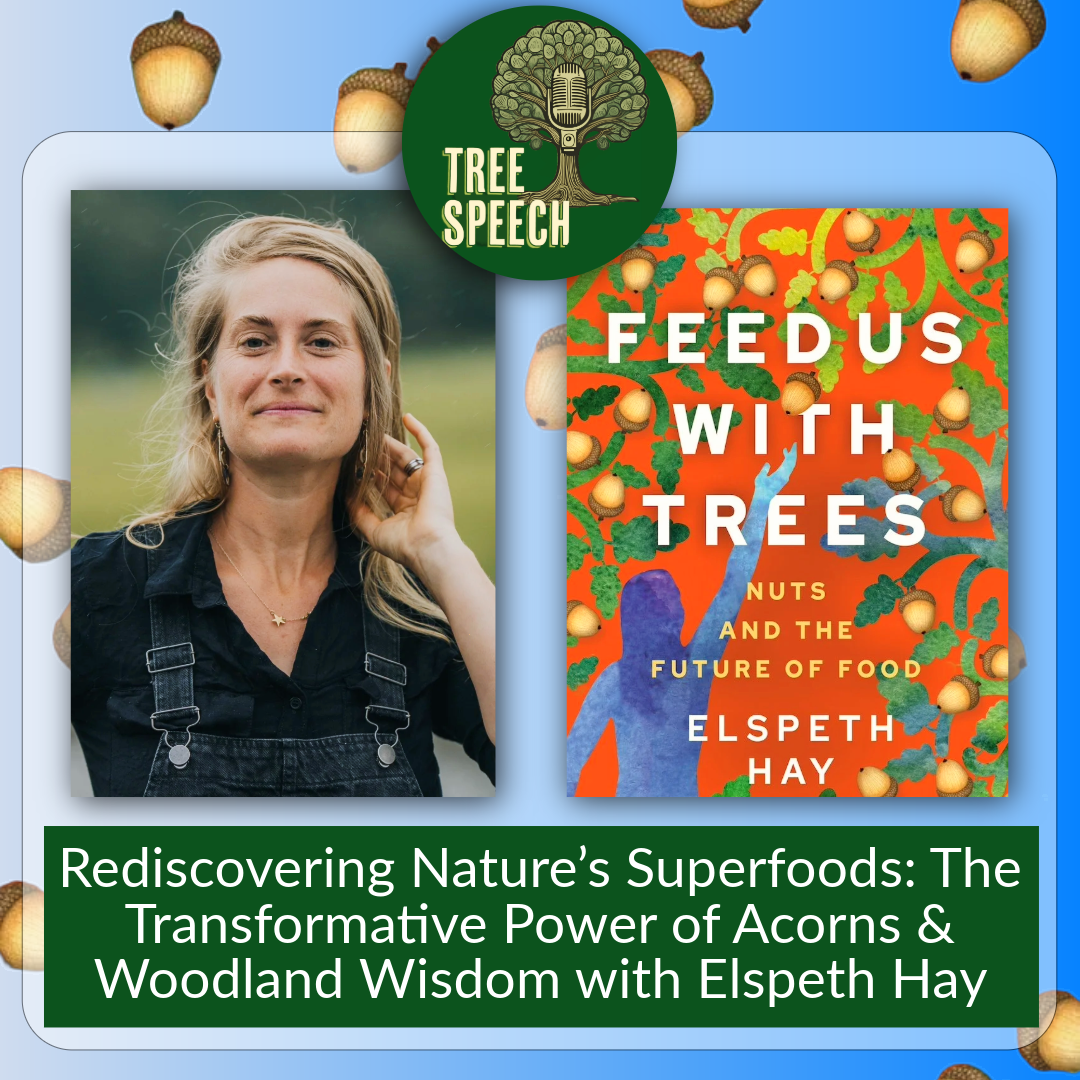
In this episode, our guest Elspeth Hay, author of Feed Us with Trees, creator of The Local Food Report, and passionate proponent of place-based living, takes us on a fascinating exploration of acorns as a superfood with profound historical roots.
Our conversation also delves into the wisdom of wooded ecosystems and the vital concept of viewing these landscapes as food-producing allies. These insights invite us to imagine a future where humans and nature thrive together, fostering a reciprocal relationship with our environment that respects historical realities while embracing the beauty of nature’s bounty.
This interview and Elspeth's book are a call to reconnect with the abundance around us, urging a transformation in our approach to food and sustainability, as we embrace the natural world’s generosity.
This week’s episode was recorded and produced in Massachusetts on the native lands of the Wabanaki Confederacy, Pennacook, Massa-adchu-es-et (Massachusett), Nauset, and Pawtucket, and in Wisconsin on the lands of the Ho-chunk, Patawatomi and Menomonee people.
Find us on Instagram @treespeechpodcast or treespeechpodcast.com. This is also where you can find our show notes and learn more about our featured trees.
And thank you for joining tree speech today.
Episode Transcript
00:06 - Jonathan (Host)
Well, good morning, Elspeth. Welcome to Tree Speech.
00:10 - Elspeth (Guest)
Good morning, it's so nice to be here.
00:19 - Jonathan (Host)
It's nice to see you. Food expanded both Dori and my minds and led to many transformative moments for both of us regarding our food systems and history and the structures and systems in our society that are in desperate need of being questioned and rethought and reworked. So your book opens with your own transformative moment, when you realized that acorns are food. Could you share with us that story and tell us what shifted in you when you held that kernel of knowledge in your hands, both literally and figuratively?
00:57 - Elspeth (Guest)
Yeah, I still remember. I was just, you know, going through emails a very normal morning and a friend had sent an email with this link to this TEDx talk and I thought like I don't really have time to watch this right now, but I'll just click on it. And it was one of those talks where, like as soon as the person started talking, I completely forgot everything else I had going on, because she said that you can eat acorns, everything else I had going on, because she said that you can eat acorns. It was this woman, Marcy Mayer, who's an expat living in Greece, and she said that not only can we eat acorns, but actually they're a superfood and one of humanity's oldest foods, and I at that point had been reporting on food and the environment for over a decade and I thought wait what?
01:44
I live in an oak forest. No one has ever said anything about eating an acorn. How is it possible that we're surrounded by all this food? I mean, acorns literally rain onto my house in the fall, they're everywhere, they're in the way, they're considered a nuisance, and it just blew my mind that this food would be all around us that we didn't even recognize as edible, and so that was sort of the start of a very long and oftentimes very surprising journey of discovery wonderfully in your book, from that moment where you realized that acorns were food.
02:27 - Jonathan (Host)
you go on to describe oak trees as being a food plant and that being an act of revolution. What do you think makes these words so powerful to people who might not consider acorns as food or who have been taught that acorns are poisonous or actually bad for us?
02:50 - Elspeth (Guest)
I grew up with a story that I think a lot of people in sort of dominant Western culture grow up with, which is this story that I call no Farms, no Food, which is also a bumper sticker for a great organization. So I don't mean to knock that bumper sticker, but it's this idea that we are separate from the natural world, even that there is such a thing as the human world and the natural world. I don't really believe in those distinctions anymore, but I very much did growing up and I think a lot of that. I trace it back into the book to the history of colonialism and capitalism.
03:27
But I didn't know any of that as a kid and I grew up in Maine with two parents who were birdwatchers and they were writing this birders guide to the coast of Maine when I was a kid and my sister and I spent a lot of time being dragged on these birdwatching trips all over Maine and visiting different habitats and I remember I don't think I could have expressed it at the time, but this sense of like what is wrong with our species, because all these places we would go, we would learn about all these plants and animals and birds, and my parents have always been really interested in ecosystems and the way that they interact, and every other species was perfectly adapted to its place and they had all these really beautiful networks to meet their needs.
04:15
You know, we would learn about sap suckers, which drilled these little rows of holes in trees and that was how they fed themselves. And I remember we banded leeches, storm petrels, and they would skim over the water off the coast of the Atlantic and feed themselves. And then we would go to the grocery store where we were getting our food from these industrial farms that I knew were destroying wild places, and I just couldn't understand why we didn't fit the same way that other species did, and to me that didn't seem like it was a cultural thing. As a kid I thought like there's just something fundamentally wrong with us. We're not part of nature and we don't fit, and I think that so many of us have grown up with that story, and so for me, learning that we can eat acorns was like the first crack into like wait, maybe that's just a story, maybe that's not like a fact.
05:11 - Jonathan (Host)
And thinking about that idea of no farms, no food. In schools and cultures, farming is often presented as humanity's inevitable destiny. So, as you're exploring all of these alternative or different ways of feeding our society and people in our country and around the world, what alternative stories of food production most expanded your imagination?
05:37 - Elspeth (Guest)
Yeah, I always thought farming was this thing that came out of the agricultural revolution right, which supposedly happened about 10,000 years ago and proceeded on different timelines on different continents and in different places. But it's sort of this crowning achievement of humanity. And while I was researching the book, when I first got interested in acorns, I read a really amazing book called Acorns and Salmon Feed Our People and it was written by a non-native sociologist, Carrie Marie Norgaard, and I reached out to her. It was about the Karuk people in present day Northern California and I reached out to her and she connected me with a Karuk medicine man and cultural biologist named Ron Reed, and this was during the early days of the pandemic.
06:23
So he and I spent a lot of time talking on Zoom and not really being able to actually meet each other in person, and he told me a lot of stories from crook culture and how for thousands of years, his people have tended oaks to produce acorns as a staple food. And the more we talked, the more I started to wonder what the difference was between farming and hunting and gathering, which is the bucket that you know most tree-based traditions have been thrown into. Because he was telling me about Kurok uses of fire and how prescribed fire in traditional crook land management. Helps keep acorn weevils, which are a pest, out of the acorns and helps control the water cycle on the Klamath River Basin. Helps prepare the ground for new acorns to sprout. Helps control pathogens. Helps acts as a fertilizer. With this recycling of nutrients and this boost into the soil and I thought okay, watering, weeding, fertilizing you know, preparing the ground for planting.
07:36
These are all the same jobs that we talk about in farming. And when I actually went, uh, and you know, at that point I had really started to learn a lot more than what I knew as a kid about the war on indigenous food systems that's been going on in North America for hundreds of years now, and so I I got curious and I thought, okay, well, hunting and gathering like that must be a really old term, right at 10,000 years. We've been talking about this revolution and actually that term came up in the 1920s and 1930s for the first time. So it came up during this period of scientific racism and is really steeped in that era and has nothing to do with actual differences in food production, which I was incredibly surprised by at first.
08:28 - Dori (Host)
Right, I'm sure. Yeah, that's pretty jarring. So there's a lot of reframing there and thinking in those terms. Your visit to Mark Shepard's restoration agriculture farm reframed your sense of what abundance can look like. What struck you the most about that landscape?
08:50 - Elspeth (Guest)
Yeah.
08:50
So Mark Shepard took about 100 acres I want to say maybe 95 acres of deeply eroded corn and soy land that had been in these monoculture crops for decades, and planted it with more than 139 edible perennial species at least as of when I visited and the difference between his land and the land around it was incredible.
09:15
It felt like walking through a nature preserve, but it was also a very active farm. So he had chestnuts, he had hazelnuts, he had pears, apples, plums, asparagus, pigs you know, a maple sugar shack, all these different species. And he had learned from another Midwestern farmer, philip Rudder, that the ecosystem that had been in the Midwest under indigenous management was something called Oak Savannah, and he basically planted a farm to try to mimic that ecosystem, except often subbing in cultivars for wild plants. So you know, cultivars have been specifically bred for yield and disease resistance and when I was there an endangered species had just moved back onto the land after, you know, decades of really ecological devastation, and so what he was doing was trying to restore land through farming, which is an idea that's really caught on in the Midwest and is spreading pretty rapidly and is exciting.
10:24 - Dori (Host)
It's really exciting. How might relearning to see abundance in wooded ecosystems change how we experience our own neighborhoods, forests or backyards?
10:35 - Elspeth (Guest)
I think that seeing our wooded landscapes as also food producing and as also, you know, landscapes where there's an opportunity for humans to take care of them and really play a positive role, can start to dissolve that line that so many of us have grown up seeing between humans and the natural world. The natural world is actually an idea that I really don't believe in at all anymore. I think there's a living world and we're part of it, and so is everything else that's alive, and the distinctions that we tend to draw between humans on this other parts of the living world are really artificial and are ways of sort of not joining and not being part of it, and I think that the more that we are part of it and the more that we see ourselves as having an active role to play, the more positive impact we can have on our ecosystems and on other species around us.
11:34 - Dori (Host)
I love that reframing. Thank you. You write about common wealth rooted in trees and shared abundance. Can you first share what common wealth is and what you've learned about it, and how might reviving this kind of commons transform both our food systems and our communities?
12:01 - Elspeth (Guest)
spent some time with Ron Reed in California and learned about a lot of these indigenous Karuk traditions, and sometimes Karuk people call themselves fix the world people, and I just kept thinking, wow, okay, so Ron is part of this culture of fix the world people and I seem to be part of a culture of destroy the world people. And why is that? What's happened to my people along the way that's gotten us into this mindset and this pattern? And so I started trying to figure out you know, when was our rupture from a lot of these wooded landscapes? Because if you go back in history, there are lots of really ancient European traditions of you know, revering oak trees, revering hazelnuts, seeing them as sacred. There were chestnut cultures all over Europe in a lot of the Middle Ages and I didn't, you know, people didn't wake up one day and decide, eh, you know, nuts no good to eat, I think we'll move on. So I was trying to figure out like what happened.
12:56
And that journey took me to Appalachia as a starting point, because, at least in Eastern North America, that's an area where, until about 100 years ago, there still were a lot of Euro-American communities heavily relying on chestnuts as a staple food and a really important subsistence crop, and when I was down there, I learned about history of commons tending, of holding land in common that I knew nothing about. It turns out that until the close of the Civil War in the United States, any unenclosed land was treated as a commons, so it was an area where you could hunt, you could fish, you could turn out animals to graze, and the laws were different in different places, but in most areas the law was that you had to fence other people's animals out of areas where you didn't want them, as opposed to fencing your own animals in, and that was a tradition that dated all the way back to England and a lot of other European countries. That dated all the way back to England and a lot of other European countries. And as I started following it and tugging on this thread, what I learned is that, in fact, so many early Euro-American immigrants came here because of an internal colonization of Europe where they lost access to these wooded commons at home, and so we're often told that European immigrants came here because it was a land of opportunity, but that's really not the whole story. About 75% of early Euro-American immigrants came because they had lost access to subsistence lands at home, and so I was.
14:35
You know that was a pretty surprising historical thread to start tugging, and it also has a really sad ending here, because what happened after the Civil War is that formerly enslaved African Americans were able to come and go from the labor market during that first year after the Civil War by hunting and gathering and foraging from these wooded commons.
14:59
And within a year of the close of the Civil War, trespass laws changed in every southern state and then that tradition spread west and north. So when we talk about why don't we have a relationship with these trees, why aren't we eating from wooded food systems, and we actually look at the history, for many people, for generations, it's been very dangerous to access this food source, and so you know and that includes Indigenous communities, african American communities and also women were some of the biggest agitators for getting commons rights backs in Europe as they lost them. So so many of the groups that are marginalized today also have a history of a relationship with these food sources and it becoming increasingly dangerous to access them, which that's a lot to put on learning. You can eat an acorn, but I just kept being more and more surprised by how far back this history goes.
15:59 - Dori (Host)
Well, it's amazing, as you tug one little bit, what else comes out. As you dig a little, what else comes out.
16:06 - Jonathan (Host)
Yeah, it's true, and a lot of this history is heartbreaking. It's eye opening and hopefully causes people to really examine our systems of today, as I said, and how things could be changed moving forward. I think one of the strengths of your book, though, is balancing these harsh realities with joy and wonder and appreciation of the natural world in your own life, the life of your family as well, and I particularly really enjoyed your chapter on twigs, which pointed to the overlooked magical parts of tree life, which included basket weaving, which you learned throughout this process of examination and research and learning. Could you tell us what have twigs and practices like coppicing taught you about reciprocity in our natural world?
17:05 - Elspeth (Guest)
One of the themes that I kept hearing from people tending nut trees in a huge variety of places Greece, california, england, all these different places was that they like interaction. Was that they like interaction. So different cultures and people in different places that I spoke with had different ways of providing that interaction. Some places people would coppice, so a lot of nut trees like to be cut back, whether that's through coppice, which is cutting back to the ground, that's more common with hazelnuts, or pollarding, which is more common with oaks and chestnuts and bigger trees, and then they'll send out a new flush of growth and that flush of growth tends to go through a stage where it produces more nuts and then slowly it gets older.
17:54
One guy told me I was asking him about an oak stand and I was like, well, I don't see a lot of acorns. And he said, well, do you see a lot of babies in a nursing home? And I was like no, I don't.
18:06 - Jonathan (Host)
Okay, I get what you're saying.
18:08 - Elspeth (Guest)
So coppicing and pollarding and also prescribed fire or cultural fire are all ways of renewing plants to not kill them, keep them alive, have them come back either from the trunk or the rootstock, but keep them producing. And it was really exciting to hear from different people how important this was, because I think in a lot of the stories I grew up with, the natural world or the living world was always better off without humans. We've all seen the post-apocalyptic movies or books and it's like, oh, the river is clean again and the trees have come back and everything's better because we went away. But actually in a lot of the stories that I heard from not tending people, these trees really need us and they really need our interaction in order to thrive. There's actually been a lack of oak regeneration in a huge variety of places over the past 80 or so years and a lot of people have tied that to fire suppression and to the elimination of some of these older cultural practices like coppicing and pollarding, of cutting them back. And so, through learning about that, I met when I was with Ron Reed in California.
19:22
There was a woman, Kathy McCovey, who showed me these incredible hazelnut baskets made by Carrick women, and I came back and I was all inspired. I thought, okay, I'm going to learn to weave with hazelnut, like that's so beautiful. But nobody in New England was teaching hazelnut weaving. So I found a willow weaving course and willow, actually very similarly to a lot of these nut trees, really likes to be cut back and can live longer with that kind of tending. And so I took a course and was immediately hooked. And now I've been selling baskets at my local farmer's market and just cannot stop weaving. There's something about the movement with your hands. But also every time I do it, I have this feeling like somewhere back in my lineage, like someone has been doing this before, like it just feels right.
20:12 - Jonathan (Host)
Yes, it's in your DNA. I looked at your social media, and the baskets that you now weave are magnificent. They're absolutely beautiful, and so it's interesting to read about the early stages of the challenges and the frustrations of learning how to do that, and then to see where you've gone to in this art in not a very long amount of time. So they're beautiful.
20:40 - Elspeth (Guest)
Thank you. Yeah, I've done a little bit of teaching of friends and I always bring my first basket with me because I'm like this is where it starts and it will get easier. It doesn't start easy.
20:53 - Jonathan (Host)
Don't be discouraged, just keep going, like any craft, honestly.
20:57 - Elspeth (Guest)
Yes, it all takes practice.
20:58 - Jonathan (Host)
That's inspiring as well. I'd like to go back to a point that you touched on, involving something else that you write about in the book of fire in shaping our woods and food systems, and I'm wondering if you could tell us how can learning from indigenous fire stewardship change how we approach today's ecological crisis in our world and country.
21:24 - Elspeth (Guest)
All over North America there's a really long history of Indigenous fire as a land management practice. There's some really beautiful writing on this from a paper co-written by a Karuk man named Frank Lake and Robin Wall Kimmerer, who a lot of people are familiar with, and they have written that you know almost every landscape in North America. If you actually look at it closely, you'll see a history of fire, and fire is, in a variety of cultures around the world, sort of humanity's defining gift as a species. If you look at mythology and cultural practices, so many places from, you know, australia to the Amazon to North America, have this history with fire and with human management of the landscape with fire. And so I first learned about it in California when I was out there and that kind of made sense to me because I thought, you know wildfires yes, prescribed burns that makes sense, we're reducing fuels. And it was also, you know, ifires yes, prescribed burns, that makes sense, we're reducing fuels. And it was also, you know, I was shown the ways that it's an important part of a food system, but I didn't expect for it to be a part of my landscape at home. And what I learned when I came back and started doing a little bit of inquiring is that actually Cape Cod also has a really long history with fire and a lot of the also has a really long history with fire and a lot of the northeast has a really long history with fire that many of us don't know about. So I think I mentioned before that white oak has been the dominant species in the northeast for 9,000 years and that's despite several periods of like pretty dramatic little climate shifts. And many ecologists believe that that's because of Indigenous burning and because Indigenous people have kept oak and other fire tolerant and fire adapted species dominant on the landscape through regular burns. And that's not to say that everywhere has historically been burned all the time. It's more of a mosaic.
23:21
So what burning does is it checks the succession of the forest. So for listeners who aren't familiar with ecological succession, it's the process where a landscape goes from like a big disturbance, a flood or a fire or plowing or something of bare earth all the way to, you know, the most mature ecosystem that that ecosystem can bear. And for a lot of places in the Northeast that's a closed canopy forest. But oaks actually don't thrive in a closed canopy forest, neither do hazelnuts, neither do chestnuts. A lot of these trees like the middle stage. So they like a little bit of space, they like to regenerate with a little bit of light.
24:00
And when you put regular fire on the landscape and different places you know have different fire return intervals is the word they use.
24:08
So like in some places you might want to burn every year and some places you might want to burn once every 10 years, it depends.
24:14
But putting regular fire on the landscape isn't just about reducing fuel loads, it also helps with that, but it also keeps succession in sort of this steady, held pattern instead of ping ponging between extremes. So like what we're seeing in California now is there'll be a wildfire, okay, that ecosystem is going all the way back to the beginning of succession and then it's moving through and then it's getting dense and overcrowded and then it's going all the way back to the beginning instead of just sort of hanging, being steady in the middle. So there's so much. You know we're used to managing succession with a plow, but many of us have forgotten that there are other tools and that there are other stages of succession where you can hold the land besides just that first stage and there's. We can go into it or not, but there are also some really important climate implications for you what stage of succession you're holding the land in and the ways that you're disturbing it.
25:15 - Jonathan (Host)
Yes, let's go into it. I know your book goes into this quite in depth and people should read the book also to hear about your experience participating in a burn near your home or within a mile or so of your home. But, yes, could you maybe highlight a few of those things that you did learn about the climate implications?
25:34 - Elspeth (Guest)
Yeah, well, one of the first things I learned was with a soil scientist who explained to me the way that every time we plow up a field, the soil is releasing carbon dioxide into the air. He called it. He said it's burping it out and what happens is that plants with their roots are storing carbon in the ground. So they're putting carbon into the ground year after year. And when you hold a forest in sort of the middle or an oak grassland ecosystem, in these middle stages of succession, instead of completely digging up the roots, you hold on to that below ground soil carbon. And so there's a pretty big difference between managing an oak grassland ecosystem, year after year after year, building up carbon.
26:24
And also, every time you have a fire, some of that burn turns to ash and some of it turns to basically biochar. So you're also there's kind of like two carbon cycles, right. There's the short-term carbon cycle, which is like, okay, a plant grows, it's releasing carbon dioxide as it decomposes, then it grows again. But there's the longer-term carbon cycle, which is where, like, fossil fuels live, and also biochar. Biochar stores carbon for a very long time. So in addition to the fact that managing with fire allows plants to keep putting carbon underground without that carbon coming out and being disturbed. It's also adding layer after layer after layer of biochar on the land every year, and when we look at prime agricultural soils all over the world, almost all of them are these molluscs which have been created through repeated fires over millennia. So that fertility of the Midwest that we're kind of mining right now with our industrial row crop agriculture was actually created through indigenous management using fire row crop agriculture was actually created through indigenous management using fire.
27:39 - Jonathan (Host)
So interesting. And that biochar you write about quite a bit as well, including the friend who now sells it, and how your plants can flourish with just the right amount of that added to their soil.
27:47 - Elspeth (Guest)
Yeah, there seems to be a long tradition of creating biochar, maybe under different names, in a lot of places sort of viscous clay, not very nutrient rich, but enhanced with broken shards of pottery and biochar to create this incredibly fertile soil.
28:19
And different cultures all over the world have been realizing the ways that biochar boosts soil fertility for a long time and it's not an amendment the way that we think of fertilizers today. It's not adding like a boost of potassium and nitrogen, it's actually creating habitat for beneficial microorganisms that then nurture and have relationships with the plants to keep them healthy when you plant with biochar. We actually just planted about 180 nut trees on some land that we own in Maine and we did an experiment where a few of the holes we didn't put biochar. Most of the holes we did, and on the first day when we were watering the seedlings in the holes with the biochar, when you walked by 20 minutes later there was still a little puddle, they still looked wet and the holes with no biochar, that water was just gone. So it's pretty interesting just in real time to see the ways that it can change the soil composition.
29:23 - Jonathan (Host)
Yes, there's much to learn, there's much information. To spread so sort of segwaying from fire into the kitchen, your book ends by bringing us into the kitchen. Why was it important for you to ground your vision and the things that you had written about of ideas for the future in recipes and meals?
29:50 - Elspeth (Guest)
I think that cooking has always been kind of my first connection to the living world around me, like my first way of interacting with excitement and love. I've always loved when you can grow something or pick something and then figure out what to do with it. I wrote a cooking column for a long time and these, a lot of these nuts were. Really. We've lost so much of the cultural knowledge around how to process and cook with them and they've also been villainized in a lot of ways through sort of the low fat craze of the 70s, and so it was exciting to me to start playing around with them and figuring out okay, if you're talking about a staple food, you're talking about something that you need to know how to cook like 300 different ways because you're eating it every day. And when I was researching the book, I have a friend who's from Switzerland and there's this mountainous town there that I ended up going to visit and they told me that in some areas of Switzerland, historically the average person ate 330 pounds of chestnuts per person per year, which when I started thinking about it, I was like that is just an incredible amount of chestnuts. I was like that is just an incredible amount of chestnuts, and so I started playing around just trying to figure out, like, if you were going to eat that many chestnuts or that many acorns or that many hazelnuts, like what does that actually look like on your plate? How are you doing that?
31:28
And what I discovered is that we know a lot about chestnuts. There's a lot of European and Euro-American history around chestnut cuisine that is very accessible. And we kind of know about hazelnuts, although most people just sort of eat them because they are delicious roasted and like you don't really need to do a lot to them. But when it comes to acorns, there has been such a war on so many of the cultures that have acorn knowledge that either that knowledge has in some cases, been lost or isn't being shared for really understandable reasons. And I started thinking about, like imagine if we lost everything that we know about wheat processing and cooking with wheat. Like how long would it take you to get to a croissant? You know what I mean? You're not going to figure that out on day two. And that's kind of where we're at with acorns, in a sense, which on the one hand, is overwhelming and on the other hand, is super fun because there's lots to try.
32:35 - Jonathan (Host)
It's an adventure and I will say I was inspired by you. I'm from Wisconsin and my dad owns some land near central Wisconsin, not far from where you were visiting, and I visited him last weekend and we were sort of talking about the book and about you and he I had no idea, but he's planted Chinese chestnut trees on his land and so I gathered some of the chestnuts. They're just like barely ripe just there, and I'll be watching for the other ones, but later this week I'm going to roast them in the oven and sort of dive right into the example that you've set.
33:11 - Elspeth (Guest)
That's really exciting and I think one of the most hopeful and exciting things that I saw as I was writing the book and talking with different people is just this incredible resurgence of interest in agroforestry in the Midwest in particular. I was just out at the Northern Nut Growers annual conference in August in Michigan and there were so many different farmers from all over the Midwest who are fed up with the current system and looking for change and who are starting to find support through nonprofits like the Savannah Institute, which is a institution, a nonprofit, promoting some of these woody agriculture crops, and they're really building community around excitement about these foods and it's a lot of fun to be in those groups and to feel the energy. And you know people are swapping recipes and people were swapping different you know foods that they had made. There were these pawpaw brownies and you know someone had brought acorn flour, and so it's really exciting to see the people who are, you know, in many ways bearing the brunt of the current farming crisis, also getting excited about alternatives.
34:26 - Jonathan (Host)
It's wonderful.
34:28 - Dori (Host)
That is really exciting, and since you've been talking to different people about different recipes of all the nut based dishes you've experimented with I assume you have not yet made the acorn croissant, but I'd be excited if you did which one are you most excited about and which one most captures the future you'd hope for?
34:51 - Elspeth (Guest)
Oh, that's such a good question. I think there's two that pop right to mind when you say most excited about. One is this chestnut mushroom saute, which I keep making and then doing different things with. One of the things that I've noticed about chestnut recipes is that so many of them are paired with mushrooms. The things that I've noticed about chestnut recipes is that so many of them are paired with mushrooms and I, being sort of an ecosystem geek, get really excited about that because they grow together. So it's always exciting to take things that grow together and cook them together.
35:23
And I have this great I think it's just called the chestnut cookbook. You just saute garlic and chestnuts and mushrooms and then you add like a tiny bit of heavy cream at the end and it sounds so weird. And as you're making it, you're like what is this? And it's so good. It's so good, it's really good with, like you know, I've had it with meat and like sauteed cabbage. I've had it in a crepe, sort of folded in with ricotta. There's just a lot of different ways to use it.
35:52
And then the other, and that you know that mushroom chestnut extension or a connection, extends to a lot of foods. I've made mushroom chestnut soups. I've made a quiche with mushrooms and chestnuts. There's just a lot of really good ways to combine mushrooms and chestnuts and then with acorns I think the most exciting thing that I've made where you know, like I said, I'm looking for that staple food. So people are making like acorn brownies and you're like, okay, but that's not a staple food.
36:20
I've been making these nut and seed crackers with an acorn flour base. So people have probably seen you know you can buy those really great seed crackers where it just looks like a bunch of pumpkin seeds and flax seeds and stuff all rolled out. And I've been making a version with acorn flour and then throwing in whatever random nuts and seeds I have. So the last version I think I did pumpkin seeds, walnuts, I had some pistachios laying around, a few hazelnuts and you just add water and I put it in a Vitamix and I you know I didn't blend it forever, but just enough that you're not getting the huge nut chunks and then rolled it out between two pieces of parchment paper and put on big flaky sea salt and just baked that until it was crispy. And that was something where I felt like I could eat this for a really long time before I got sick of it and it was delicious.
37:12 - Dori (Host)
Those both sounds so delicious and so dynamic that you could like pair them with different things, and you know you can find a ton of variety with them.
37:23 - Elspeth (Guest)
Yeah, and a lot of the nut cultures. What's cool is that you know, often like I went to Corsica actually right after finishing the book, which had been a dream of mine because they have this really ancient chestnut system and so many of the tree-based systems it's not just the trees, the trees are in a relationship also with animals that are producing either meat or milk, and so there's often this chestnut cuisine all over Corsica. They had like chestnut sausage, the chestnut fed animals that the milk had been turned into cheese, and so then you've got that nut seed cracker with like a little piece of sausage or some cheese, and then you're really feeling like, okay, this is good.
38:05 - Dori (Host)
We can go on like this for a while. You're like now we're moving, moving in the right direction. Now we're moving, moving in the right direction. So, speaking of moving in that direction, you've called oak trees are a food plant, a revolutionary statement. For listeners who feel inspired but maybe a little overwhelmed, what are small everyday acts they can take to join in that revolution?
38:34 - Elspeth (Guest)
So first I just want to credit Alan Bergo, who is the first person that I read who said that I have his book.
38:39
It's amazing, he calls himself the forager chef, and I think that small steps that people can take is first, to really learn and understand the history of how we got to where we are in our food system and in our cultural relationships with Indigenous people, and how the landscape got to be where it is today.
39:04
And then what I think is really simultaneously terrible and exciting is that all of the problems that we're experiencing today are connected, and when we trace them all back, they're really all rooted in our current economy and our current agreements about property ownership and money. And so anything that you're doing to take that apart and to rebuild something different, I think is part of the solution. And for people who like things to be a little more specific, I would say one thing you can do is get to know the keystone plant or animal species in your area. Anytime that you are increasing habitat or well-being of a keystone species, you're increasing life in your ecosystem where you live, and so anything that you're doing to learn more about and help tend keystone species is increasing life, and that's kind of what it's all about.
40:09 - Dori (Host)
That is kind of what it's all about and that's a beautiful way to think about it and to frame it, especially for those of us who are really shifting the way we think about food, the way we think about agriculture, the way we think about community, to share your research, to help us on that journey as we shift our perspectives. And, Elspeth, we truly appreciate the way you tug at strings, your ability to research the history of the land, of agriculture, of the way people live, of the way people eat, of connecting with so many doers, listening to the living world and sharing all this with us in your profound book and today in this conversation. Jonathan and I found it so inspiring, and even more so to hear you speak face to face. It's just so wonderful. So thank you for your work and your words and we're going to support you all the way in spreading this important information, sort of the way you spread seedlings of hazelnut, chestnut or oak trees. Thank you so much for today, Elspeth.
41:20 - Jonathan (Host)
Thank you.
41:21 - Elspeth (Guest)
Thank you so much for having me. It's been a pleasure.