

Embracing Autumn: Exploring Fall's Myths, Traditions, and the Sacred Cycle of Transformation
Unlock the secrets of autumn's transformation and embrace the season's bounty as we kick off the fourth season of Tree Speech. You'll journey with us through the crisp air of an orchard, soaking in the wisdom of harvest time and apple picking. With a special contribution from gifted storyteller Heather Porter, we'll navigate the dormant months of the earth and reveal how this natural cycle mirrors our own paths to renewal and strength. Together, we'll re-examine old myths and uncover their impact on our modern belief systems, all through the lens of ecofeminism and interconnectedness.
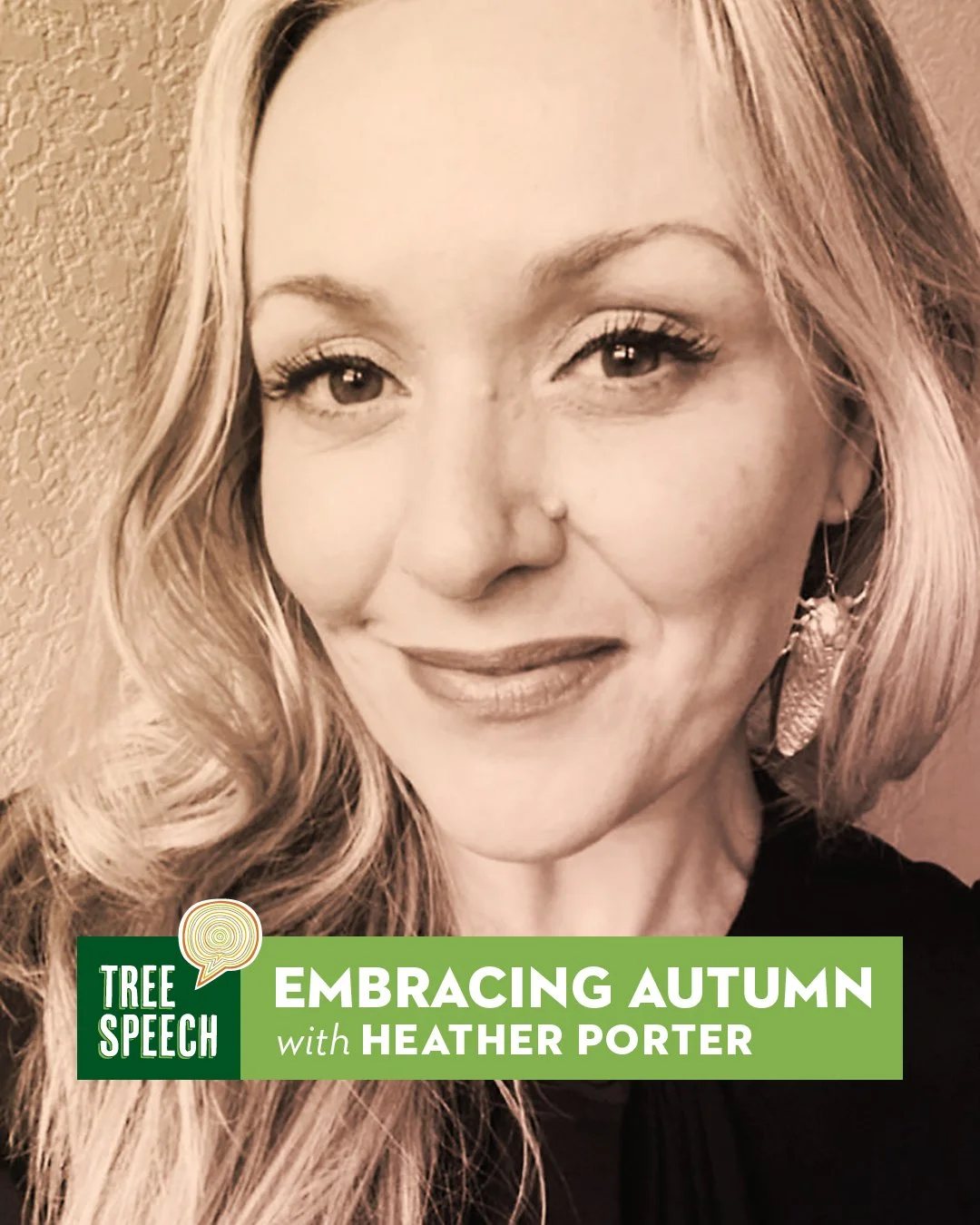
It is also a pleasure to be joined by Heather Porter of the Animisma podcast who shares a profound and heart-felt meditation on the power of transformation that is a result of letting go-both in nature and our own lives. Embrace an empowered narrative as we reflect on the sacred cycle of transformation, inspired by the apple tree's journey from blossom to fruit to decay. Heather will guide you in reframing traditional narratives, emphasizing the importance of intentional release and renewal. By rethinking our connections to nature and one another, we create a more honest and peaceful future.
Heather Porter is a writer, storyteller, and advisor. She's been called an empath, a sensitive compass of compassion, and a 'Rosetta Stone' for the soul and was led to her work through a lifetime of translating the intersections of the ecological, spiritual, and scientific for others. Rooted in her Celtic ancestry, those who lived closely to the land, waters, and seasons, she lives as an animist and her work contemplates the myriad aspects of a sovereign life, seeking to reveal the wonders of the natural and the etheric in service of connection, reverence, and deep, honorable communion.
Spirit, grace and a deep, unyielding love of the Earth is at the heart of all she does. She has undertaken depth studies in animistic, shamanic, Celtic, and Eastern spiritual practices and holds a Bachelor of Environmental Science with Honors and a Master of Environmental Law.
Episode Transcript
00:10 - Dori (Host)
Hello Tree Speechers. It's been a while. How are you doing? Did you spend any time with the trees since we were last together?
00:19
For today's episode, the first of our fourth season, we'll embrace autumn by exploring this changing time, all while harvesting one of the favorite fruits of the season apples, with a visit to an orchard. Later in the episode we have a special guest contribution from Heather Porter, a writer, storyteller and fellow podcaster who uses her background and studies in animistic, shamanic, celtic, as well as Eastern spiritual practices and environmental studies and law to share wisdom about living in harmony with the earth. Heather will guide us in thinking about the earth going dormant in the cooler months, a powerful journey towards strength and renewal. So throw on your favorite flannel as you join me, your host, dori Robinson, for Tree Speech, a podcast where we strive to listen to the forest through the trees. This week's episode was written and recorded in Massachusetts, on the native lands of the Wabanaki Confederacy, pennacook, massachusett and Pawtucket people. In New York, on the native lands of the Wabanaki Confederacy, penicuik, massachusetts and Pawtucket people. In New York, on the lands of the Lenape tribes and Colorado, on the traditional lands of the Ute, arapaho and the Ochiti-Sacoan. The Seven Council Fires Tree Speech is co-written and produced by Jonathan Zautner and Alight Theatre Guild.
01:49
Let's begin this new season together with an old story. One day, the earth goddess Gaia made the flowers along the plains of Nysa especially radiant. She did so as a favor to Hades, her brother, who had fallen in love with a young maiden named Persephone. Hades asked Persephone's father, zeus, for her hand in marriage, and Zeus agreed. Persephone herself was unaware of this deal. Instead, hades asked Gaia to make the beautiful plain of Nysa even more glorious, so that Persephone and her friends would be lured away to gather roses, crocuses, violets and irises. Persephone was lost in the wonder of the day when she came upon the Narcissus flower. In myths and poetry, the Narcissus flower is said to give a sense of holy awe to both immortal gods as well as humans. Persephone smiled and, gazing at the flower, reached out with both hands, and it was then that the earth opened up under her. Hades made his lunge, seized her against her will and put her on his golden chariot and drove away. As she wept, she cried with a piercing voice, calling out for help. Her mother, demeter, ran swiftly to her daughter's voice but couldn't find her. She and Hecate, a goddess of witchcraft, magic doorways and the moon searched for Persephone for days.
03:26
Demeter was the ancient Greek goddess of grain and agriculture and was so bereft at the absence of her beloved daughter she caused the crops to stop growing. A terrible famine spread across the land. The gods pleaded with Demeter to lift the famine, but she vowed not to budge until she could hold Persephone in her arms again. Finally, zeus allowed Persephone to return to the earth, but before she was able to leave, clever Hades fed his new bride six pomegranate seeds, which then bound her to the underworld, seeds which then bound her to the underworld. Persephone did return to the world and to her mother's love, but had to spend one-third of the year with her husband Hades. Now, every fall when Persephone descends to the underworld to be with her husband Hades, demeter causes the crops to cease growing. When Persephone returns from the underworld in the spring, the crops and new growth begin again.
04:31
This myth was most likely written to explain the cycle of the seasons, but to be honest, it doesn't sit well with me. Zeus and Hades have all the power and make a decision that changes Persephone and Demeter's lives without so much as including their desires, needs or even thoughts. The women are not part of the discussion whatsoever. They do not have autonomy over their bodies or their lives. It is worth examining the meaning of this myth and how it affects our belief systems to this day, of this myth and how it affects our belief systems to this day.
05:08
What is not always acknowledged from the myth is the fact that, as ecofeminism scholar Gloria Femmine-Orenstein explains, the fates of women and nature are always entwined within a patriarchal ideology. Even more, we as a culture forget that a goddess civilization once existed, in which women were powerful and in charge of agriculture, as well as the fact that all humans are a part of nature, not above or outside of it. In fact, demeter was once an important part of ancient Greek life, celebrated and honored during a yearly festival called the Thesmophoria that was held around the time of the harvest and that honored human and agricultural fertility. The festival was one of the most widely celebrated in the Greek world and was restricted to adult women, and the rites practiced during the festival were kept secret. The story of Demeter and Persephone speaks to me of the power of women, their insight, strength, knowledge and ability to heal themselves and those around them. This is also what we are focusing on this season women, their stories and their innate interconnectedness to nature, especially given the recent events of the overturning of Roe versus Wade and the direction of policy changes regarding women's health and how it intersects with environmental health. We will showcase this season how specific women walk through the world, connect with their surroundings and stand up for what they care about. It is their nature, it is our nature. I am thinking about these myths and stories as I enter the orchard. Taking time outside and connecting with these apple trees allows me a chance to take a breath and to see the gifts of the season.
06:58
I'm fortunate right now to live very close to several orchards in the Merrimack Valley, which is where I'll be picking today. The farm starts with a few large barn structures, places to pick up jams and jellies, hard ciders, baked goods, vegetables. It's a quick walk from here to the orchards themselves. Picture a big open area with rows and rows of neatly lined apple trees, all with shiny green leaves and different hues of red fruit. The newest saplings are sectioned off with a ribbon to give them a chance to grow. I'm walking into a row right now, so I've got trees on either side of me. This whole area is so picturesque and so pastoral. The trees are taller than I am, perhaps 8 to 10 feet high. They're dense enough so that I can't exactly see the next row over, but open enough to hear the other pickers enjoying their day nearby. It's something I did not grow up doing, since I am from Cape Cod, and apple orchards, for sure, are not something that you find in great mass. You have to go far off Cape for that, so it's a delight now to be able to drive just a few miles and be able to find them.
08:19
The equinox, as we've discussed, means equal night, and it's when the hours of light and dark are equal. It's also the time of the harvest. We've been growing things throughout the spring and the summer, and the harvest is a time to practice balance. There's equal hours of daylight and darkness, there's the gifts of the earth, and there's also the knowledge that pretty soon the crops will turn, brown leaves will fall and everything will go dormant. Also, once we celebrate the equinox, the nights will turn, brown leaves will fall and everything will go dormant. Also, once we celebrate the equinox, the nights will begin to be longer than the days. This makes this a time to harvest not just the food elements, but whatever you've created over the spring and summer, it's a time to gather the resources that you have to see you through these darker months ahead. As we switch from being outside so often and seeing the sun so often to moving farther into hearth and home. My way is always to like turn it gently and see if it wants to come with me. Oh, it did. Oh, it's my first apple of the season. Oh, make something special with that. That's exciting.
09:25
Apples and honey are a big traditional food in Jewish culture. So Rosh Hashanah, the head of the year, is coming up, so this apple will become a part of that festival, part of that ceremony. Fall has always been a sacred and reflective time for me. Between my Jewish practice and my continued engagement in education, I've always experienced September as the start of the year.
09:51
Rosh Hashanah means head of the year in Hebrew and is the Jewish new year. It's the holiday which begins the days of awe, the high holy days 10 days of reflection and prayer. And Rosh Hashanah falls on the first day of the Hebrew month of Tishrei, which usually falls in September or early October. It doesn't align perfectly with the Gregorian calendar because we have a lunar-solar one. Some traditional ways to celebrate are to attend synagogue services and recite special liturgy reflecting on forgiveness and compassion liturgy reflecting on forgiveness and compassion. And gathering as a family for festive meals. Apples are traditionally dipped in honey and eaten as a symbol for a sweet New Year. The High Holidays end with Yom Kippur, the holiest day of the Jewish calendar. It is a day set aside for intensive meditation, prayer and fasting. I fast and meditate as well, but not in the traditional setting of a synagogue. Instead, I take my thoughts to the woods and go for a very long, silent, solo hike, so that only the trees are my companions, and that's when I begin my reflection with journaling. Rosh Hashanah begins September 25th this year, around which time you'll hear Jewish people greet one another by saying Shana Tova, or Good Year, or even say Shana Tova Umetukah, a sweet, good year.
11:21
The autumnal equinox gained a new name in the 1970s after neo-pagan academic and poet Aidan Kelly used the word Mabon in a pagan craft calendar. He noticed that in many cultures there were complex myths associating the fall equinox with the rescue of a young person from death, which these stories go all the way back to 1500 BCE, probably much earlier. One of these myths are the myth of Demeter and Persephone. Kelly didn't find a similar myth in Anglo-Saxon literature, but did find one in Welsh stories. Mabon is the son of the Earth, mother Goddess and a god of light himself. He was kidnapped from his mother when he was three nights old, and his abduction caused an absence of light. Eventually, he was rescued by none other than King Arthur himself. Mabon grew to become an excellent hunter and possessed a nimble horse and a magnificent hound, and is even said to have joined some of the adventures of the Knights of the Round Table.
12:29
Some of the main themes of the season are fruitfulness, harvest, prosperity, abundance, gratitude, giving, transition and balance. Okay, I'm going to try with the second apple. This one's a little bit redder. Okay, that one is a. No, that one's not ready. That's okay. Despite this gorgeous red color, these aren't ready. Yet we have come upon prime pumpkin spice time. Ever since Starbucks introduced the extremely polarizing pumpkin spice Spice Latte in 2003, this flavor has come to dominate the fall.
13:10
Pumpkin spice is now notorious as being basic. However, it is anything but simple, and its origins far predate the 2000s. Pumpkin spice does not, in fact, contain pumpkin. Rather, it is a combination of cinnamon, nutmeg, clove, ginger and allspice. These spices are native to Southeast Asian islands, and some could only be found in certain parts of Indonesia known as the Spice Islands. For a while, their location was a closely guarded secret. The Dutch took control of the Spice in the early 1700s and, with the successful trading of the Dutch East India Company, the spices eventually found their way to the New World or America. Yes, pumpkin spice has saturated the market. However, this wasn't always the case. Again, because the spices are not native to the United States, for a long time, only the wealthy could enjoy them. Furthermore, there's a reason why these items are used to flavor foods so much at this time of year, and it comes from herbal wisdom.
14:18
These seasonings don't simply taste good, but they take care of our health too. For example, cinnamon stimulates the digestive track, giving us the ability to digest heavier winter foods. It also increases circulation throughout the body, keeping us warm. Like cinnamon, ginger is used around the world as a warming spice that stimulates circulation. Additionally, it has anti-inflammatory and antiviral properties, making it incredibly useful during cold and flu season. Not only do cloves smell wonderful, but they also stimulate the mind while relaxing the body. They are also the strongest provider of antioxidants.
15:00
In the group, allspice is the unripe berries of the plant Pimenta diawica, which is native to Central America and the Caribbean. Like the others, allspice is a great digestive aid and is also used for nerve pain, bruises and fatigue. Lastly, nutmeg was traditionally used as a remedy for insomnia, nervous tension and lowering blood pressure. There is archaeological evidence that nutmeg may have been used by humans 3,500 years ago. These spices enable a person to make a tea or salve as a way to help soothe colds, flus, nausea and so on, but these are all herbal remedies that were often used by women in the kitchen and were thus dismissed as not medical enough or, alternatively, deemed as too witchy. Ridiculing the use of these spices continues a long history of dismissing herbal home remedies and also dismissing women's wisdom, and while these are not substitutes for Western medicine at all, there is a valuable wisdom passed down from one person to the next, wisdom that can be honored and celebrated even in one's latte. It's clear that we're in need of this because the craving for pumpkin spice has begun earlier and earlier in the last several years, sometimes starting as early as August. Comfort, healing and other elements of the divine feminine are emerging in popular mainstream culture, and I, who add cinnamon to my coffee every morning, personally welcome this shift.
16:40
Celebration of the end of harvest and beginning of winter date back thousands and thousands of years. Both the spring and autumn equinoxes are marked in Japan with a ceremony known as higen, which means the other shore in Sanskrit. Since the equinoxes celebrate the times of year when day and night are of equal length, they represent a balance between light and darkness and thus are symbolic of a middle way or a union between the spiritual and physical worlds that is so central to Buddhist beliefs. For three days before and after the equinoxes, in March and September, the Japanese paid their respect to their deceased ancestors by visiting and cleaning family grave sites. Then they offer prayers, fresh flowers, incense and food to their ancestors. It's just beginning to rain now, so if you're hearing that lovely tipping tapping sound, that's what that is, which is good. There's been quite a drought, even in Massachusetts, so the trees need it. The full moon observed nearest the autumnal equinox is considered to be the brightest and largest full moon of the year.
17:52
Many East and Southeast Asian cultures celebrate a festival around the harvest moon that is among their year's most important holidays. The Chinese and Korean cultures are two of the biggest celebrants of this festival, china celebrates Zhang Zhizhi, or the moon festival. It traditionally includes family reunions, moon gazing and sharing moon cakes, round pastries with a variety of sweet fillings. The moon cakes are often cut into pieces equal in number to a number of family members, reinforcing family togetherness. In a similar festival in Korea, chuseok is celebrated as a national holiday. People travel to their ancestral and parental homes where they eat traditional sweets, play games and pay homage to elders and ancestors.
18:41
I would be remiss if I did not mention Pomona. While in an apple orchard, pomona was the Roman goddess of abundance, who was the keeper of orchards and fruit trees. She does not have a direct Greek counterpart, but is often associated with Demeter. In Ovid's writings, she is a wood nymph who rejected several suitors before finally marrying Veritomnus, who was quite lustful. So the two together are responsible for the prolific nature of apple trees. Today, pomona has become associated with flourishing of all fruit trees in general. She is often portrayed in paintings bearing a cornucopia or a tray of blossoming fruit. Her name extends from art to science, as Pomologists are scientists who study apples and their growth. The history of bobbing for apples also has its roots in the Roman festival of Pomona.
19:37
Not every fall celebration continues today. There is one in particular, that is, a lost harvest holiday called Mechelmas. Beginning during the medieval period, mechelmas was considered one of the holy days of obligation for Christians, although that tradition ended in the 1700s. It was celebrated on September 29th and, like other celebrations following during harvest time, michaelmas can trace some of its traditions to early pagan practices in Europe. One of the most popular harvest customs that was adapted by Christians and integrated into the Michaelmas celebration was that of a corn doll.
20:17
The history of the corn husk doll dates back to Native American craftsmanship. It's unknown when the practice of making corn husk dolls began among colonial peoples. However, we do know that these dolls were made by European settlers and enslaved African Americans. It was understood that the grain fields had spirits and the corn doll represented the spirit of those rows and sheaves of grain. A doll or corn mother was created, often from the final sheaf to be threshed, and it was treated with great honor and reverence. The doll provided a place for the spirits of the grain to rest until the next harvest season rolled around. The more respect you paid to the corn doll, the more likely it was that the spirits of the field would bless you with abundance and growth in the following year.
21:09
In a symbolic sense, because Michaelmas is so close to the autumnal equinox and because it is a day to honor St Michael's accomplishments, which includes slaying a fierce dragon, it is often associated with courage in preparation for the darker half of the year. The rain is beginning to come down hard, so I'll take my apples with me and leave the orchard soon, grateful to have these tasty and fragrant reminders of the joy of fall. Beyond joy, fall can stir many emotions as daylight shrinks and colder weather creeps in. Daylight shrinks and colder weather creeps in. To process these range of feelings, from joy to hesitation, we've asked writer, storyteller, advisor and fellow podcaster, heather Porter, to help put the season's changes into context.
22:04
Heather walks the path of the wise woman tradition, a path of integrity steeped in intuition, connecting, reverence and remembering. She skillfully and courageously weaves the universal truths of our everyday experiences with mystic wisdom. Spirit, grace and a deep, unyielding love of the earth is at the heart of all Heather does, and she was led to her work through a lifetime of translating the intersections of the ecological, spiritual and scientific for others. In fact, her wonderful podcast is called Animisma, which offers a bridge toward reclaiming the indigenous wisdom of her Celtic ancestry, the collective living peoples and cultural lineages of Scotland, wales, ireland and England, as well as lands that spread across Northern and Western Europe and England, as well as lands that spread across Northern and Western Europe. We began this episode with an old myth written by men, about the changing seasons. Let's reframe the old narratives around the seasons change, this time from the perspective of an empowered woman. Here is Heather Porter sharing with us a meditation on sacred rot.
23:19 - Heather (Guest)
The autumnal equinox is upon us, a favorite time for so many of us that live closely to the seasons. This is the second of the three Celtic harvest festivals, the one that signifies and celebrates abundance, and for many it is the closure of the wheel of the year. So often, when thinking of the harvest, we think only of the grains, fruits, berries and vegetables offered by the natural world and plucked by human hands or foraged by bear or bird. This time of year is also one of release, deep, abiding release, and by staying intentional with our release, so much can be healed, transmuted and nourished. The apple is sacred in Celtic lore and is a tree revered at this time and has been for centuries. Once the fruit has been eaten, it is said that the hero can never return to being what they were before, that they are fundamentally changed, initiated into the mysteries of the goddess, the mysteries of death and transformation. At the autumnal equinox, its fruit are full and have fallen from the trees, adorning the ground in greens, reds and golds. As the apple tree prepares for its journey to the root, to sleep through the cold nights of winter, its energies are pulled downwards. Its leaves, now withering and falling from the tree, are to be digested by the mycelia, hidden beings of the dark earth, rotting softly and slowly through the winter, nourishing the next cycle of growth. Once the sun returns, Generous with its release, every leaf and old branch lovingly returns to the earth to nourish the next sapling flower or tree. What if the apple never released its fruit or its leaves? Where would the space be for new growth next year if it was doomed to hold on to everything it had created? The beautiful tree would be cluttered and potentially even become ill, sending energy to old fruits, completed offerings, rather than to its own roots.
25:48
In the winter, Fruits and leaves fall to the earth to rot in divine cycle. They are not intended to remain on the branch. To release is sacred, necessary and divine. We nourish the future by feeding the rot and digestion of our being, just as the apple nourishes the future by offering the rot its leaves, fruit and branches. So let's consider ourselves for a moment as an apple tree. The sun is waning, the nights grow longer, We've completed the growth half of our year, yielding the fruits of our labors, and now must prepare for the long dark nights ahead. Are we doomed to hold on to everything, Every offering, every thought, every achievement and every idea, or are we able to gracefully surrender to the movement of the season, releasing all that has lived its life, completed its cycle and no longer serves us, such that it can be offered to the hummus of our spirit and nourish ourselves for the next cycle? All of this is achieved through the sacred rot, the blessed rot, the digesting of all such that the future may be nourished.
27:03
It is a journey through shadow, dark, unlit places populated by magical and magnificent mysteries that take what has been completed and digest it such that its teachings, nutrients and energies can be used for future thoughts, deeds and actions. This is true not only for apples and leaves. It is true of our own completed deeds, thoughts, paths and prayers, and it is as true for us as it is our communities, our governments and our societies. Digestion resulting from a lease is part of an infinite cycle of life and rot, the rot which we eschew and deny, is one of the greatest and most sacred blessings of them all. What a gift. The dark places are taking that which has been discarded and completed, moving it through a profound and beautiful cycle of transformation. Rot is a blessing beyond belief and deserves to be fed. Life ceases to flourish in the face of a depletion of nutrients, Sacred rot and transformational shadow balance, emerging life and energizing light During this beautiful time of cooling days. This day of balance of light and dark, is also a gentle and valuable time to consider wounds that need healing, cleaning and mending.
28:32
Wounds yield profound wisdom when they're given the opportunity to heal. Wounds yield scars and scars yield stories. Stories that sing, that sting, that bring the wound complete, stories that hold memory and teaching, stories that might prevent future wounding if they are given the space to murmur among our thinking and remind us of choices that were made that did not serve the collective. There are only two choices we can ever make those that heal and those that harm. The healed wound reminds us of harmful choices that were once made or experiences that may have been inflicted upon us and, if healed gracefully and completely, a healed wound can create space for a more aligned, honest and peace-filled future.
29:24
Wounds that are not allowed to heal, however, deepen pain and prolong suffering. They grow and spread and require an inordinate amount of energy to maintain. Often, it is far simpler to clean the wound and allow the air and light to tend it than to operate as though the wound doesn't exist or isn't so, or we've only ever known it, and so we replace its bandages rather than facing the hard task of its acknowledgement, cleaning and clearing. This may not be easy work, yet it is absolutely the work worth doing. Sadly, in this world of control, riddled with fear and fed by corrupted desires, we seem to perpetuate the deep and dark wounds of our society's pasts, patterns that shackled people and destroyed the earth, never letting the central core of the wound be cleaned and offered, through intentional ceremony, to that sacred place of completion, rot, transformation and transmutation. We are being called to reclaim ourselves and our relationships to the earth and to each other, in loving harmony, mutual respect and collective responsibility.
30:41
At this time, Blessed kin of flesh and leaf, we do not need to hold on to the old ways that no longer serve us. We do not need to repeat the patterns of control and harm any longer. As we witness the airing out of long-held wounds of our societies, they require tending, gentle and swift scraping of old patterns and laws, patterns lovingly offered to the earth, held only in memory, sewing up of the now cleared wounds with threads woven of integrity, honor and hope. Scars must form over these patterns and ways, scars of the reckoning, of the clearing, of the healing of our cruelty towards the earth and towards each other, cruelty towards the earth and towards each other, Scars writ as memory of times past and actions past and grief. We cannot forget the profound and sacred grief we must partner with so that the memory of the wound is metabolized and does not stay activated in our collective and individual systems. The grief that metabolizes the pain of our ancestors, that discharges the energy of the protective anger. The grief that washes over us in soft healing waves lest we forget, lest we repeat. Grief that washes us of all that separates us and helps us to claim our collective humanity, that polishes our sight such that we see ourselves reflected in every other face, every stone, every leaf, every sparkle of light on a rushing river. So here's to the autumnal equinox.
32:42
So here's to the autumnal equinox a balance of light and dark and a time of great change where we welcome the harvest of abundance while offering to the ground all that has lived and all that we've outgrown, either asudges and old pains all be scraped from the wound of our collective humanity and lovingly be offered to the earth, so the mycelia of our collective consciousness can engage in the sacred rot to transmute old and outdated patterns and ways of living and thinking into nourishment for the evolutions in thinking, creating and living.
33:12
Blessed be the sun. Be the moon. Blessed starfire. Blessed be the winds. Be the rains. Blessed. Frog choir. Blessed be the swamps. Be the bogs. Blessed quagmire. Blessed be the marsh. Be the glade. Blessed death pyre. One day, may the glorious and graceful rot of our bodies nourish the earth, as the fallen leaves, the broken branches and the old wings of bees and butterflies soften and blacken and go to ground. Blacken and go to ground. May our vessels rot deeply and sacredly so that whatever nourishment we hold is harvested by the sapling and the flower, and perhaps even the apple tree. May the cycle continue.
34:22 - Dori (Host)
Earth everlasting Everlasting and to learn more about us, please visit treespeechpodcastcom. We're thrilled to be able to offer interviews, creative insights and stories about the natural world we live in and the trees who guide our way. Please consider supporting us through our patreon. Every contribution supports our production and we'll be giving gifts of gratitude, including an invitation to Treehouse, our new virtual community for patrons of all levels. Please also consider passing the word to tree-loving folks and rate and review us on Apple Podcasts. Every kind word helps.
35:00
Before the rain takes over completely, I'm going to grab a few more apples and race home to make cozy tea with warming spices. Few more apples and race home to make cozy tea with warming spices. I'm so excited about the journey of this upcoming season both fall and season four of the podcast, as we examine old myths and systems and rethink them through our interconnectedness to one another trees and nature. Episodes will drop every other week. Our next episode will be on September 30th and we'll focus on the intersection of reproductive and environmental justice. So please continue to tune in as we listen to the forest through the trees, and thank you for joining Tree Speech today.