

A Love Letter to a Tree: Inside the Immersive Art Experience Arborlogues
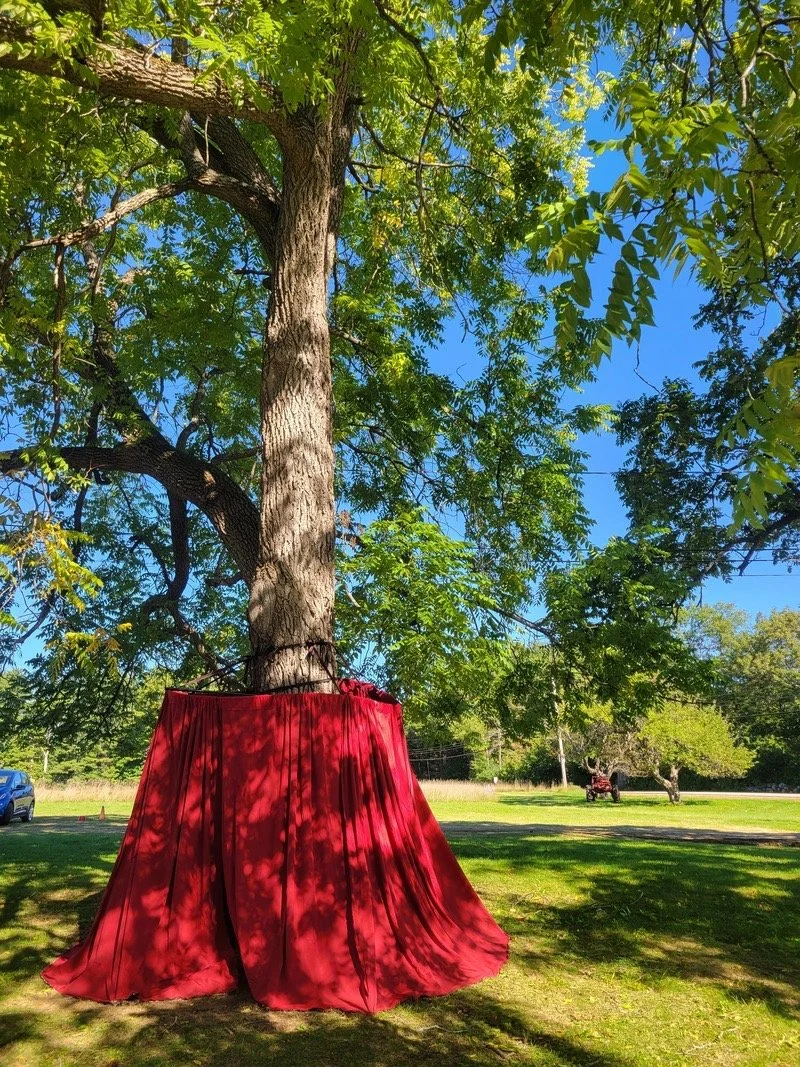
In the season of Valentine’s Day, we often focus on romantic love — but what if intimacy could extend beyond human-to-human relationships?
In this episode of Tree Speech, we explore a radical and tender idea of connection through Arborlogues: A BOTANICAL RECITAL PERFORMED FOR ONE TREE.
Created by lead artist Dan Daly and writer Lee LeBreton, Arborlogues invites participants into a red-curtained theater built around a chosen tree. Guided by a script, you become both performer and conversational partner with your arboreal audience. The result? A deeply personal encounter with presence, memory, ecology, and love.
Jonathan speaks with:
Dan Daly, scenic designer and immersive artist whose work has appeared Off-Broadway, at the Under the Radar Festival at The Public Theater, RuPaul’s DragCon, and beyond.
Lee LeBreton, performer and writer with the New York Neo-Futurists, who crafts the evolving script for each tree and each location.
Together, they discuss:
How Arborlogues was born during pandemic isolation
What it means to let a tree “tell you” what the play wants to be
The emotional range participants experience — from joy to grief
The healing power of naming our climate emotions
The importance of quiet reflection in a noisy world
This episode also honors the work of Joanna Macy, whose teachings on “The Work That Reconnects” inspire the piece’s invitation to transform grief into belonging and active hope.
The episode closes with a guided reflective exercise led by Dori Robinson, inviting listeners to write a love letter to a tree — an act of relational love rooted in gratitude, accountability, and care.
What if loving a tree is not sentimental… but necessary?
This week’s episode was recorded and produced in Massachusetts on the native lands of the Wabanaki Confederacy, Pennacook, Massa-adchu-es-et (Massachusett), Nauset, and Pawtucket, and in Wisconsin on the lands of the Ho-chunk, Patawatomi and Menomonee people.
Find us on Instagram @treespeechpodcast or treespeechpodcast.com. This is also where you can find our show notes and learn more about our featured trees. And thank you for joining tree speech today.
Episode Transcript
00:00:00 Jonathan: As Valentine's Day approaches, our thoughts often turn toward the art of intimacy, the ways we open our hearts, speak our truths, and connect deeply with others. But what if we broadened that idea of intimacy beyond the human to human? What if love could be felt in the quiet communion between a single person and a silent, rooted being that has stood witness to generations of life? I'm Jonathan Zautner, and in this episode of Tree Speech, we explore just that kind of tender encounter through the work of the artists behind Arborlogues: A botanical recital performed for One tree. Arborlogues invites a single participant into a red curtained theater built around a chosen tree, where, guided by text and prompts, you become both performer and conversational partner with your arboreal audience. It's an experiment in listening, reflection, and closeness with a tree at the center of the stage. Today, we'll talk with the creators and performers who have brought this poetic form to life, uncovering how Arborlogues dissolves traditional boundaries between audience and performer, nature and human, and how these encounters can evoke some of the most intimate reflections of all about love, presence, loss, and the ecosystems that hold us. Today's guests include Arborlogues lead artist Dan Daly, a Hudson Valley based scenic designer and visual artist who specializes in site specific and immersive work, and whose design work has been seen from Off-Broadway to the Under the Radar Festival at the Public Theater to RuPaul's Dragcon and around the country and world. We are also joined by Lee LeBreton, who wrote the text for our blogs. Lee works regionally and internationally as a performer, writer, Deviser producer and teacher. His artistic home is with the New York Neo-futurists, where he's been an ensemble member since twenty eighteen. Join us as we consider what it means to be in relationship with a tree, especially in a season built around hearts and connection. Let's listen.
Well, hello Dan and Lee. It is so exciting to speak with you today. Welcome to Tree Speech. I'm glad you're both here and that we will speak about your project Arborlogues, which I came into contact with or awareness of through the great New York Times article that was written about it last summer when you had your project in Chelsea in New York City, and I'm excited to dive in to more of the details of how this project began and your thoughts on it and where it's going.
00:03:09 Lee: Thank you so much for having us, Jonathan.
00:03:11 Jonathan: So Arborlogues was born out of pandemic restrictions in twenty twenty one. Can you take us back to that cedar in Prospect Park and tell us what was happening in your lives? And how did a tree become your collaborator?
00:03:27 Dan: Yeah. So Arborlogues is a one person at a time theater piece where you are the performer and a tree is your audience. So you show up, we go. Thank you so much for for being here today. The costume designer says what you're wearing is perfect. Here is the script. Please go into this red curtain theater that I have built that straps to a tree and perform the play for the tree. It started all the way back then, in sort of pandemic times, where I was working with an organization called the Peace Studio, and the Peace Studio is an organization who tries to further peace around the world and all of its different forms. And they were giving out small grants to organizations and people and artists that were interested in finding a way to further peace through their art. So I as a set designer, during the pandemic, there was not much work happening in the world that was necessary for a set designer to be part of, for theater particularly. So I got a hold of this small grant and then reached out to Lee to see what we could come up with that did that. We were talking about something called reflective practice, where you kind of use something as a mirror to the self, and how you can see yourself through that object or that that idea or thing. And after many conversations, Lee and I landed on trees, and particularly on sticking with one tree and seeing if you can find yourself and find a relationship through that singular tree.
00:04:52 Jonathan: So describe the experience that the person who is a part of this undergoes. So they're given a script. Is that right? Written by you Lee. What does that script contain and what is that experience?
00:05:07 Lee: The script is handed to you by a stage manager. A little spoiler the stage manager is usually Dan or I, dressed in green with a headset and a clipboard. You open it and it is written so that you can be onboarded to that experience without having ever performed before. It sort of teaches you right at the top, like, hey, everything in in italics is stage directions. These are things that you will read silently to yourself. Everything else you can read out loud, and you begin by sort of giving a curtain speech, you know, an MCs welcoming speech to the tree. You introduce yourself. We do a lot to sort of establish the tone, to get people comfortable and grounded in the world that they're entering in. So there's there's some jokes, there's some lightheartedness, there's some acknowledging of the silliness, of the activity that you're about to do and the hope with that. The intention with that is that it gets our audience slash performer comfortable, puts them a little bit, a little bit more at ease if they're feeling a little bit of stage fright. And then we're sort of off to the races and we explore a lot of different, a lot of different, sort of like emotional territory. We ask the audience member to reflect on different moments from their life, that they've built memories with a tree, or just with the color green, or with themselves as an organism, as part of a biological system, and also on the history of the tree that they're performing for that day. Um, and that way the, the script changes each time that we do it. It's very, very customized to the location and the specific tree species and all of that. So there's a little bit of, um, personal excavation. There's a little bit of history. Uh, there's a little bit of, uh, there's a little bit of biology and ecology, and you're completely alone for the fifteen minutes. Usually runs about fifteen minutes. There's a brief intermission where the stage manager makes another appearance, and then, uh, when you close out the performance, you, uh, you emerge from the theater. We we take your script. I often ask, like, well, how did it go? Uh, we have a little a little debrief afterwards, and we give you a program of your performance that includes the, the like, the performance credits, things that you would usually expect to see in a, in a, in a program, but also, of course, lists the performers as you at the end.
00:07:35 Jonathan: That's wonderful. As you're developing the specifics of of each tree that the people will encounter and, and have a conversation with. You've both described the project as allowing that tree to tell you what the play wants to be. How do you listen for what a tree is asking.
00:07:57 Dan: That you know? That's a tough that's a tough one, right? The first part of that is finding the tree to perform for us. We have a lot of ways out there to see where we want to do the piece next, and see which trees are of the ilk for this type of production. You know, we need one that has a strong enough trunk that can support the theater, because the theater hangs off of the tree itself. We normally find an institution that's interested in presenting this piece, and then working with them to see which tree around is the one that is the the most correct for the piece. Which one has a story to tell? Which one has the strength to hold it? Which one is, you know, not having a lot of other stuff around it so that we can actually get to the tree to perform for it. So that narrows us down. But then once we kind of find the one or two trees that we're interested in, we start doing our research. You know, just like anyone would do with any sort of piece. So we learn the the type of tree, which isn't always the easiest thing to do. We, we figure out how old it is, which also isn't the easiest thing to do. And then we start developing a story from the trees. Like if it's a if it's a pine, does that mean that we go down American history to understand how pines are imbued into America? If we're, you know, over in New Zealand, you know, we can't meet that tree ahead of time. And, you know, who are we to kind of go to another country to teach them about their own trees? So maybe there's a different story we're trying to tell there. So I tend to package up a lot of information in a research package. Um, and then I hand it off to Lee to let Lee figure out what the story is.
00:09:36 Jonathan: The curtain creates a temporary theater around the tree, and it's almost like a shrine or a ritual space. And the participant has a very intimate encounter with the tree. I know some of these participants have described guilt or grief and others. The range goes to complete joy and friendship for both of you. What have you noticed about the emotional range of people's encounters with the tree? Especially if you're the stage manager? You're also, you know, part of it sort of, uh, playing a role, but also, I'm sure, uh, being aware of how it's affecting people. Do you see those tears, laughter or moments of silence as part of the performance as well?
00:10:22 Dan: I would say one hundred percent. One of the things I think that Lee does so beautifully with the text and that we're trying to do with the piece, is, you know, we're reforming it for each tree for but not just for the time and not just the time in the place that we're at at that specific time, but also the emotion that we're at as, as individuals, but also sort of as a society. And I think that there's, uh, you know, we, like you said, we get the full range of emotions. We have people that leave that are absolutely giddy and giggling and thinking that it was such a fun thing for them to do for the day. And I've had people come out that were virtually inconsolable in the emotions that it brought up for them about their own relationships to nature, their own relationships to themselves, their own relationships to it. Um, and what was really exciting, I think, about this last one that we did at the Cell Theater, um, Nancy Manichaeans the cell was that we had so many more people come see it in one specific setting. So we saw that range really on display through the whole the whole three weekends that we did it. What's also really exciting about it is because you're by yourself there when when you leave, a lot of times people want to chat. People want to talk about their own history with a tree or their own story of something that happened to them. One that particularly sticks out to me is very much at the beginning. Uh, there was someone who we were talking to, the cedar tree or performing for the cedar tree. And afterwards he left, saying that he had just had to empty out his, uh, I believe it was either his father or his grandfather's house, um, who had just passed away, and they had just spent weeks stripping and cleaning these cedar floors. Um, and then he came and was able to speak with the cedar tree. It's those small moments that are really what make this piece that someone goes in and does it, and it brings something up to them that they never drew a connection before between.
00:12:13 Lee: I'm thinking also of the the young person who visited Arbor when we were in, uh, New Zealand, where with a gorgeous festival in Wellington, New Zealand called the Performance Arcade, we reached the part in the text where we talk about the age of the tree, and that participant realized that she was the same age as the tree and had been witnessed to the same, like environmental events of that time period. and she got very emotional during that, during that time. Um, and I, I as much as I want to, as the writer, want to take credit for the tremendous emotional experience that people have, I think a big thing that's doing the heavy lifting is one the setting. We often are blessed with these majestic settings that you could be sitting in complete silence or taking a phone call, something extremely mundane in those settings, and would probably be moved in some way, uh, on a, you know, on a beautiful summer's day by standing under a beautiful pagoda tree. But I think specifically when we did it this last time in Manhattan, it's very rare that you get a moment of quietude in the middle of twenty third Street. Uh, and I think that people were maybe a little surprised that this beautiful backyard where our the star or the guest of honor, our pagoda tree was. I think people were surprised to encounter a backyard in that kind of urban environment. Um, it was also the space was also sort of shockingly quiet. And I think there's a lot of folks, myself included, who live very, very busy lives, who are on the average day are carrying around a lot of anxieties or worries or are holding a lot in their head, and permission to be very quiet and reflective and basically alone for fifteen minutes is really ripe. Conditions for everything that's going on below the surface to bubble up. I'm I'm delighted when our show is the thing that sort of forms a an open, free, relaxed, safe channel for that to happen. Uh, but I think people are also just really hungry for quietude in nature.
00:14:26 Jonathan: Exactly. I think that's one thing a lot of people, especially a lot of people in Manhattan or any of the five boroughs of New York City or other, uh, cities they are yearning for. You don't get that unless you actually seek it out or someone provides it for you as as you are doing with this experience. I do want to also ask one question about the script for you. Lee. I know that in the script, people are asked to name a word aloud about climate change and that this is both simple and powerful. And I'm wondering, why did you want that vocal moment included in the script?
00:15:03 Lee: The idea had a pretty direct inspiration. There is a environmental activist, uh, who passed away very recently named Joanna Macy, whose work I discovered relatively recently in the time that I've been working on Arborlogues. Uh, she worked extensively with Nuclear Disarmament, um, and then wrote a lot of very powerful essays and a book about addressing burnout in an activist community that's up against an opposition as intense as a changing climate or as a planet, and one of the practices that she recommends is identifying the source of any negative emotions that you have tied to thinking about nature, thinking about the planet, thinking about changing planet and changing climate. And she, uh, she has a chapter for addressing each one about guilt and numbness and things like that. And I remember reading that chapter list, and just seeing those words broken down brought intense clarity to my own emotions about, uh, about climate change and how hard they've been to sort of parse out. And that gave me the idea to invite our audience members to put words to the often, I imagine, very messy feelings about their relationship to nature. And they really run. They really run the gamut. You know, the collection of words that we include in the script, we We sort of create a word cloud for them to choose from, and they're free to say whatever they want, or I guess, nothing at all. But Dan, I remember you also encouraged me like, hey, a lot of these words are negative. What if we put some positive ones that would maybe not occur to you or I, but could be possibilities maybe for some people. So we built out this this word cloud. And it's my hope that there's there's something useful about that. The dream is that there's something healing about it, maybe, uh, or productive, uh, or maybe like even activating about it because I think that's really, uh, that's really valuable thing to be reflecting on, like naming the feelings that you have about this scary global event. And then, of course, as we know, once you name your emotions, you are a step further to processing them. There's also a moment that I took a lot of care with, uh, to give people privacy around. When I'm the stage manager, I have to stay close by just in case anything happens, I just be able to step in and do things. But that was one moment that felt so private that I often may found myself making extra sure that I was a step away to like, really give people that that privacy is there is something very vulnerable about about naming, I mean, guilt or confusion or apathy. And, you know, I would want people to know that they were able to express that without judgment, like, I don't I don't want to be there to judge. I certainly have my own words from that word cloud that I feel, but wanted people to feel relaxed enough to do that.
00:18:06 Jonathan: Thank you for sharing that. And I'm sure people going in had no idea that they might be confronted with with that. And and yes, I do believe it is healing. I think we all carry some sort of climate grief, even unnamed, just because what's happening to the to the earth is happening to us because we're all connected to it. So what a wonderful chance to start to unravel that for people through this artistic experience. This last iteration that occurred in Chelsea was the seventh, including the journey that you also mentioned to New Zealand. Do you imagine that arbour logs will continue, and if so, where might it go next?
00:18:50 Dan: That's the million dollar question, right? Um, we we are always open. I'm speaking maybe for Lee a little bit, but we're always open to to new renditions of it. Thumbs up. Great. Um, we're always open to finding the next one. You know, it's it travels well, but when we're doing it, we, you know, we don't make a living off of doing arbour logs. So we're always trying to find a way to make a piece that can go somewhere and support whatever community or whatever organization needs it, while also being able to physically get it there. So we were in talks with a couple people about next ones, but nothing in the books yet. We kind of do it when when it percolates up into the next time to do the piece, it becomes the next time to do the piece. It's kind of how we feel.
00:19:36 Lee: I would love to do Arborlogues in a different biome. If we got to go to the desert, I would love. I would love that. I have a lot of fondness for the Pacific Northwest and a lot of the old, old trees out there. I'm ready to write for a Pacific Northwest redwood or whatever you've got.
00:19:58 Dan: Sort of. Intellectually, I'm really excited to someday do it for a tree that's never been outside, one that's, you know, in a in a mall or in a, you know, something that it doesn't know what nature is. It just is a part of it. There's a there's a tree that used to be up in I live in Newburgh, New York, um, that they cut down several years ago, and there's just this big trunk left behind. And I'm interested in what's, you know, how else can we talk about trees beyond just the one beautiful one in the middle of a field.
00:20:30 Jonathan: Something tells me the importance of this piece, the importance of trees telling their stories, and the fact that everyone should have this experience will give it some longevity. I know that we'll be seeing many Arborlogues iterations in the future. Before we close here, could you tell us where we can keep tabs on Arborlogues and on both of your work? Maybe we'll start with you, Lee.
00:20:56 Lee: Online, you can find me at Lee LeBreton. I'm also on Instagram pretty actively at underscore Disco Juice. Um, and you can see me throughout the year writing and performing with the New York Neo-futurists. I'll hand it over to Dan.
00:21:11 Dan: Yes. Um, you can find more about Arborlogues at my theater's website. Office theater. Theater. Com. Um, and you can find me at Dan Dailey. Com. Um, and I, uh, teach up at Suny New Paltz, So if you're interested in that type of theater, come on up and take a couple classes. And I'm also a member of the National Queer Theater. So we do a festival. We do many festivals throughout the year. Um, if you're interested in any of that type of work.
00:21:41 Jonathan: We will put links in our show notes to all of your work, and we'll be keeping tabs, like I said, on our blogs. Thank you to both of you for being here today. I really believe there's no greater work than to connect people with trees, nature, and art. And as you said, to allow this entertaining, healing, and wonderful experience to take place. So thank you again for your work and for joining us today.
00:22:07 Lee: Thank you so much.
00:22:08 Dan: Thank you for having us.
00:22:12 Jonathan: Life is always full of synchronicity. I was surprised when Lee spoke of being inspired by the profound work of Joanna macy, as I too have been leaning on her work and writing for hope and inspiration, for insight and Encouragement and direction. I want to speak about the kind of love that Joanna macy has spent her life teaching, a love that includes the earth. Joanna macy reminds us that grief for the world is not weakness. It is proof that we love when we feel sorrow for forests burning, for rivers drying, for species disappearing, that ache is not something to suppress. It is a doorway, a doorway into belonging. She calls this the work that reconnects the movement from separation to participation, from seeing the world as out there somewhere, to remembering we are part of it. Arborlogues was born from that. Remembering to build an immersive art piece around a tree may seem simple, but in Joanna's frame it is radical. The tree is not backdrop. It's not a prop. It's not a metaphor. Even though I love a good metaphor, the tree is presence, a collaborator. When we gather around a tree and listen, really listen, we are practicing a different kind of love. Not possession or extraction, but attention. And maybe this is what Valentine's Day is really about. What would it mean to love a tree the way we love a person? To show up consistently. To witness its changes. To sit in its shade without asking for anything in return. To accept that the relationship changes us. Joanna macy speaks of active hope, not optimism, but participation. Love that moves. Love that acts. Love that chooses to stay in relationship even when the future feels Uncertain. Arborlogues is an offering in that spirit. It is a love letter written in presence. A circle drawn around a living being, and an invitation to remember that we belong to one another, human and more than human alike. So today, at this time of Valentine's Day, we honor Joanna macy for teaching us that loving the world is not naive. It is necessary, and that when we gather around a tree, we are not just making art. We are practicing love. And perhaps in that practice, we remember how to love everything else too. And now, to help us move from words into experience, Dori Robinson will lead us in a short practice, a simple exercise to feel that love wherever we may be. Whether you're near a tree, sitting indoors, walking or listening from your car. This is an invitation to pause. To soften and to reconnect. Dori, we turn it over to you.
00:25:35 Dori: With Arborlogues as our example, and in this season, often associated with love. We're going to explore a different kind of intimacy, one that isn't about romance or even about another person, but about our relationship with the living world. Joanna macy writes, just as lovers seek union, we are apt when we fall in love with our world to fall into oneness with it as well. We begin to see the world as belonging to us as intimately as our own bodies. Perhaps loving a particular tree can be one of the ways we fall into that larger love. Take a moment to think about a tree or element of nature that matters to you. Imagine yourself standing near it. If it's a tree, maybe even sitting under their branches or leaning against their trunk. Now we invite you to write either in your mind or on paper, a love letter or valentine to this tree or object. Not a romantic love, but a relational love, the kind rooted in gratitude, accountability, and care. This letter can be as long or as short as you wish. If you need some guidance, here are three prompts to help you begin. Our first prompt is thank you for what is this tree? Given you shade, beauty, shelter, a place to think, a companion, and grief or joy. Our second prompt is I wonder what. If you have ever wanted to ask a tree a question, now is your time. The tree has seen so many things seasons, time, hours, years, storms, days, nights, events both large and small. What would you like to know? Through the perspective of this tree. Our final prompt is I promise to. This can be small. I promise to notice you. I promise to visit you. I promise to slow down when I walk past you. Or to tend the soil by your roots. Take a breath here and then write whatever else you'd like to say or that comes to mind. A love letter is more than poetry or sentimentality. It's a statement of commitment, a reminder that love is not just something we feel, but something we practice. In this way, loving a tree and having compassion for nature is not so different from loving a person. We listen, we take responsibility and show up again and again. Now that you've written your letter, consider where to place it. Maybe bury it near the tree or keep it in your journal. You could even read your letter aloud to your special tree. May this small act of love ripple outward from this tree to the forest to the whole living world.
00:28:53 Jonathan: Thank you. Dori. And from that place of connection, may we move forward with care. We send our love to you all. Thank you for joining Tree Speech today.